Waves of Emotion: Helping Children Recognize the Power of Silence

“Peace: It does not mean to be in a place where there is no noise, trouble or hard work.  It means to be in the midst of those things and still be calm in your heart.”

Author unknown

I am not a quiet person.  I like to talk.  I like to laugh.  Those who know me well describe me as an extrovert.  And yet, the older I get, I wonder if that’s really true.  I find that as I get older, the more I rely on my inner voice and the more I learn to appreciate silence.  When I need to make a big decision I certainly like to talk to others, but ultimately I find I am able to find answers when I am quiet. When I take time to consciously stop and reflect, things become clear. Times like spring break, Christmas break and summer provide natural opportunities to read, reflect, and think.  I appreciate these quiet moments and recognize I need to schedule them into my day when life is operating at the regular pace.

imageThis spring break, I am on vacation with my family in San Jose del Cabo.  As I write this blog, I can hear the waves from the Sea of Cortez crashing against the shore.  They sound like thunder yet soothe the soul and remind me of the power of the universe. At the shore, the waves are giant as they crash against the sand, yet further out in the distance, the sea appears calm.  At the surface, the water churns with emotion, and yet, deep within, a place of calm exists.   Listening to the waves, I can’t help but recognize a parallelism that exists between the sea and children. Like the sea, children are full of emotion.  The emotions of children are often unpredictable, can change in a moment, and can range from pure jubilation to stormy seas in a matter of moments.  Authentic emotions roll freely from children, as they have not yet learned to hide emotion.  As parents and educators, we face the challenge of helping children return to a calm place while managing our own emotions at the same time.

When I think about the teens I have worked with as an educator, I recognize that so many of them are also like the crashing waves.  They have highs, lows, and a range of emotions that surface from positive and negative stressors.  It seems more and more common to work with children who struggle with depression, anxiety, or difficulty managing the stress in their lives.  As I start to recognize the power of silence, I wonder if we are allowing our children to grow up with enough down time built into their days.  Do we help kids find the calm that exists within them?  As parents I wonder if we are teaching our kids to appreciate silence or have we created negative associations with quiet time by using strategies such as ‘time out’?

As a parent, there is nothing I want more than my children to grow up ‘happy’.  When I say I want my children to be happy, that does not mean that I want to give in to their every wish and surround them with material items.  Instead, I want to help them grow up with the habits that truly create happiness.  The science of happiness studies the habits of truly happy people.  These habits include positive thinking, altruism, exercise, gratitude, connection to others, relaxation, reflection and stress management.  So I stop and ask… how many of these habits do we teach to our children?  As a parent, I can think of ways I teach my children to think positively, give to others, exercise, connect and show appreciation; but I’m not sure I have put as much effort into teaching my boys how to relax, reflect and manage stress.  When I think of our schools, I see the same pattern.  Schools today seem busier than when we were kids.  Emphasis on cooperative learning and the integration of technology has a positive impact but also adds a new level of connection.  This is an exciting time, and learning today is an incredibly rich process.  As classrooms become more dynamic, do we need to be consciously aware of the quiet time we schedule into the day? Should we ask ourselves how we are teaching our students to relax, reflect and manage their stress? Kids today grow up with high tech toys, the internet at their fingertips and activity filled schedules.  Do we allow for introverted children to shine? Do we teach extroverts the power of silence? Many schools have implemented MindUP training to help children develop mindfulness but unfortunately it seems to be a program of choice based on the teacher rather than a competency that children of all ages are working towards.

imageDuring spring break I am able to spend fun filled days with my kids from morning until evening. Our days are full of swimming, beach walks, activities, games, time with friends, and constant conversation. Our kids have a rich and wonderful life. However, we don’t seem to have much down time built into the day.  Even ‘down time’ often involves the TV or a high tech toy.

The more I read about wellness and happiness, the more I recognize the importance of silence in our daily routines. Silence can take many forms (meditation, mindfulness, yoga, reflection, journaling, etc).  Just last night I watched a video clip where Marci Shimoff speaks about happiness and how it was managed in indigenous cultures.  When someone was feeling depressed, they would visit the Medicine Man or Shaman.  He would ask four questions:

When did you stop moving?

When did you stop singing?

When did you stop telling others your story?

When did you stop having time for silence everyday?

Just last week, my two boys had an argument. As I was getting ready for school my youngest son, age 5, was at my leg crying.  He had been first to the remote control yet his brother, age 8, came along and took the remote to turn the TV to his chosen show. Through tears, Cole said “I was watching the Black Show and Jaden changed the channel and the Black Show is my favourite!”  I asked Jaden why he had changed the channel, only to discover that Jaden had taken the remote because Cole had not turned the TV on. His favourite show, The Black Show, meant he was holding the remote and staring at the black screen.  In the moment this seemed cute and funny.  Today, reflecting on life at a busy pace I wonder if I missed a moment for Cole to enjoy the silence.

Like the crashing waves, we have emotion that rolls from us throughout the day, yet like the sea, a place exists within us where we are calm.  How can we teach our children to find the calm beneath the waves? When spring break concludes and we return to the hectic pace of regular life, I hope to make moments of silence a routine for my children and I.  And next time my five year old grips the remote and asks if he can watch the Black Show, the answer will be a definite yes.

Happy Spring Break!

Redefining School: Thomas Haney’s Self Directed Model

Imagine you are on an airplane, mid-flight, and you strike up a conversation with the passenger beside you.  Together you start comparing high school as you know it from your hometown.  If you are from BC, you would likely share some personal experience while outlining the basic framework: 30 students per classroom, 1 teacher per room, different curriculum for each course, 4 classes per day, 5 days of school per week, 8 courses per year, bells to dictate start and end times, etc.  Although your description may include some variations on school culture and unique attributes, the basic learning environment would likely sound similar regardless of who was telling the story…unless you are from Thomas Haney!

Six weeks ago I began a new position as Vice Principal at Thomas Haney Secondary.  I have held off blogging about the school until now as I wanted to have time to experience the culture and understand the model before sharing it publicly.  Although I am certainly not an expert, I feel confident describing what makes Thomas Haney so incredibly unique!

Thomas Haney is part of the Canadian Coalition for Self Directed Learning. Following a unique model, each student is on a personalized learning program where they have the ability to explore their passions and focus on their strengths as they work towards graduation.  Students develop competencies necessary for life after graduation including communication skills, planning, an understanding of their learning style, organization, negotiation and technological literacy skills.

When students begin grade eight, they become part of a multi-grade Teacher Advisory (TA) Group.  Essentially, this becomes their home base or family at school.  TA meets at the start and end of each day.  Students stay with the same teacher for TA throughout their five years of high school. This allows for very strong relationships between teachers and students, and allows parents to have a key contact at the school for communicating about their child.  The teacher advisor is in frequent communication with the other teachers to stay informed of the progress the students in TA are making in their coursework.

Each day, students use their planner to set their learning goals for the day.  They use the morning TA time to determine what they are going to work on, where they will be working, and what their weekly goals are.  The teacher advisor signs off on the plan after discussing it with the students.

Each course at Thomas Haney is divided into twenty learning guides.  As students complete learning guides, they track their progress in their planner to communicate with their TA and their parents.  Teachers from each course will pace the course and communicate with students about which learning guide they should be working on.  The school is not self paced, though the structure and learning is self-directed so that the students have opportunities to decide what to work on when, and how to demonstrate their learning.  This often leads to creative explorations where students follow their passions  and engage in projects that meet the learning outcomes of multiple courses at the same time.

As students progress through the grades, their schedules allow them more flexibility, and more control over their own learning.  In grade eight, all students are in set classes all day.  Each of the eight set classes meet three times per week.  Many choose to participate in our grade eight laptop pod where every student has a laptop with the necessary resources instead of a bag full of textbooks.  On Mondays, grade eight’s join all other grades in a one hour ‘Y’ block where students choose where to work and what to work on.

In grade nine, each course meets two times per week instead of three. The remaining blocks become work blocks, where students plan their own day and choose their work areas.  Each department has a ‘Great Hall’ where students can choose to work.  Teachers also have flexible schedules with a mix of set classes or time in the great halls supporting learning.  In grades ten through twelve, most courses meet for one set class per week with the expectation that the student attend the great hall at least two times per week to work on that particular course.

What is the result?  Well, here are some of my first impressions.  First of all, the teachers have an increased amount of time to collaborate as they are often in shared work spaces that lend themselves to natural collaboration.  Next, the relationship between students and teachers is very strong.  As you walk through the great halls you see teachers sitting next to students working one on one or in small groups, allowing for individual attention and meaningful dialogue.

What surprised me most, is how able the students are at handling the increased responsibility.  Almost all students rise to the challenge and as a result, there are very few behaviour issues.  As you walk through the school you see students from all grades working in the same areas, helping one another, and working with the teachers to guide their learning.  While working on curriculum, students are also developing competencies that range from time management to creativity.  As an example, just last week, two students who had never worked together before began talking and decided to create this amazing spoken poem about social justice. They will share it live at the upcoming Maple Ridge Social Justice conference.  They will also share this with their Socials and English teachers to see what learning outcomes this project meets.

The open structure and flexible scheduling also lends itself nicely to unique school events during the day such as the recent ‘Poetry Slam’ contest pictured here photothat took place in our English Great Hall.  Next week for spirit week, all students dress in colours representing their TA’s, and participate in a variety of events culminating with the annual Gym Riot where the colours compete in friendly competition.

Finally, what I have recognized in my short time here, is that the staff and students of Thomas Haney absolutely love their school.  They are incredibly proud of the unique model, and appreciate learning in a way that models what we see in the changing workplace.  Graduates leave feeling ready to embrace the world, with the competencies necessary to navigate their next adventure in life.  And, if that next adventure finds them on a flight, I can assure you they will have lots to talk about when they spark up a  conversation addressing what high school is like in their hometown.

Love Is Louder Than Bullying: Why I Believe in Restorative Justice

Mother Teresa once said “If you hold an anti-war rally, I shall not attend.  If you hold a peace-rally invite me.”  As we approach Anti-Bullying day, I am hopeful that we will use the day to reflect and think of our own actions, and what we can do to model appropriate behavior.  I wish that we could re-frame the day with a new label, focusing on the behaviors we want to see.

As an educator I am hesitant to say I don’t like the term anti-bullying because I worry others will misunderstand my intention.  In no way do I support bullying behavior, however I am an advocate for positive approaches to behavior where the goal is to repair harm rather than assign blame.   Why?  I think Todd Whitaker answers it best in this video clip “What Great Teachers Do Differently”

http://www.youtube.com/watch?v=VXCl2fMsdTU

Put simply, hurt kids will hurt other kids.  If we focus on punishing the child, we teach shame and the chance of that student hurting others rises.  When we label students as bullies we focus our efforts on determining who is guilty and who is innocent.  This stems from our criminal justice system so it is a natural way of thinking for most of us.  However, I challenge you to ask yourself this: Do you believe our criminal justice system strengthens individuals and helps improve their skills before reintegrating them into society? I’m assuming most of you will answer no.

Last Friday I had the privilege of presenting a workshop on Restorative Justice during a professional development conference.  As a teacher, counselor, parent and administrator I am a huge supporter or restorative approaches as a method of responding to behavior.  Restorative Justice is a model based on control theory, which centers around the belief that the only person’s behavior that we can truly control is our own.

To help explain the model, I will use a real example that I helped mediate between two students (though I will change the names).

Sally came to the office to report her wallet stolen from the school change room.  She hadn’t locked up her belongings and when she returned from PE her wallet was gone and her bus pass and money were missing.  After looking at the security cameras we developed a list of students who went in and out of the change room during that period.  Through conversation with Amy, a student who should not have been in the change room that block, we were able to determine that Amy had taken the wallet.

From a punitive perspective our goal would be to determine:

-What rule has been broken (respecting others property)

-Who is guilty? (Amy)

-What the consequence should be (likely a suspension)

From a restorative perspective our goal would be to determine:

-Who has been harmed? (Sally)

-What relationships have been damaged? (Sally and Amy’s, Amy and the school as trust has been broken, etc)

-How can relationships be repaired? (Amy taking responsibility, Amy accepting a related consequence, Amy understanding the impact her actions had on Sally and the school.

-How can Amy learn from this situation and return to the group strengthened?

In this particular situation, I will never forget the impact the mediation had.  Amy agreed to return the wallet, but had already spent the money.  She was in ministry care and struggled to come up with the funds.  Rather than having her re-pay Sally, the school offered to re-pay Sally while Amy volunteered time at the school to pay back the school.  Amy also met with our liaison officer to understand the severity of shoplifting or stealing from others.  However, the most powerful moment came when I brought the two girls together.  Amy was able to apologize for her actions, but also explain why she had made such a bad decision based on her financial situation.  Sally was able to accept the apology, but also explain to Amy that her family had struggled financially throughout her childhood.  She was able to explain the choices she had made rather than stealing.  Watching the girls talk openly, they were able to understand more about one another.  Sally got her money back and Amy was able to take responsibly and return to the group strengthened.  Amy did not steal from students again the rest of her days in high school.

Tomorrow is anti-bullying day.  I challenge you to see the day in a positive light. Remember that as adults, we are all teachers.  When we see bullying, let’s focus on the teachable moment to strengthen our children rather than focusing our energy on assigning blame.  As coined by the Coquitlam School District, “Love is Louder Than Bullying”.

The Habit of Happiness…

The greatest revolution of our generation is the discovery that human beings, by changing the inner attitudes of their minds, can change the outer aspects of their lives. ~ William James,  Science of Happiness

Take a second to think about your workplace.  Think about the employees who work there and think about their overall level of happiness.  It is quite likely you can imagine your co-workers along a continuum.  Some individuals seem to have a natural gift of happiness, viewing the world in a positive light, while others seem to carry extra weight on their shoulders, overcome with negativity and the roadblocks that stand between them and happiness. We all know someone who seems to suffer with Monday Misery. The person who walks in Monday morning only to ask if it’s Friday yet.    Imagine choosing to hate one out of every seven days just because it’s Monday. It’s like choosing to be grumpy for twelve years, if we assume the average life span is just less than 85 years of age.

I own a water bottle that is covered in inspiring quotes on the outside. One quote, which receives some debate, states  “The pursuit of happiness is the root of unhappiness.” I like it for two reasons: First, I like it because I agree with this idea, and second, I like it because there is an element of awareness that arises once you take responsibility for your own happiness level, and recognize how flooded our society is with others who don’t.  Just this morning I read a front page newspaper headline quoting a teenager who claimed the actions of others have ruined her life.  If only the teen could recognize that viewing her life as ruined is actually a thought she has full control over. When we attribute happiness to external factors, we create a moving target that we are always running towards.  To stop and find happiness within allows us to be present and enjoy life now.

Shawn Achor, gives a fantastic TED Talk outlining The Happy Secret to Better Work.  Achor recognizes “It’s not necessarily the reality that shapes us, but the lens through which your brain views the world  that shapes your reality.  And if we can change the lens, not only can we change your happiness, we can change every single business and educational outcome at the same time.” When our brains are happy we produce more dopamine which stimulates learning, creativity and energy levels.   Creating this environment in our schools and teaching students how to be happy has positive impact in the classroom and beyond. According to Achor, our external world only predicts 10% of our long term happiness in life.  The other 90% is determined by how our brain processes information.  The great news is that we can re-train our brains, once we recognize how to be happy.  I know that when I am stressed the habit of happiness is something I need to be conscious of and sometimes I need to schedule strategies into my day.  While psychologists of happiness may have a variety of tricks, these are my favourites that work best for me.

1) Exercise.  I know that when I work out in the morning, I am a better mom, a better wife, and a better educator.  When life becomes busy this is often the first habit to quit, yet it most needed during stressful times.

2) Gratitude.  I like to end each day thinking of five things I am grateful for.  I need to make effort to share this gratitude with others.   I love the quote “Feeling gratitude and not expressing it is like wrapping a present and not giving it.”

3)Journal.  Writing thoughts down always feels therapeutic to me.  Not only does it allow me to release emotions, it allows me to put things in perspective and ask myself why I feel the way I do.

4) Sleep. I hate to admit this one as it makes me feel old.  I used to live on 5 hours sleep per night.  Lately I really recognize that a little extra sleep has an amazing ability to shift the lens of how I view the world. A tad ironic that I’m typing this tip at 1 AM.

5) Be Still.  While I love the chance to talk with friends and family, especially when I am feeling unhappy, I also recognize that the final conversation needs to be a chat with myself.  The answers are within. Happiness does not come from pleasing others but rather from listening and trusting our inner voice.

6) Take Responsibility. There will be days, weeks and perhaps years that are more difficult than others for each and everyone of us.  As we face adversity, challenge and change, our sense of belonging and well being shifts. I like to remind myself regularly that although I do not have total control over what happens to me, I always have control over how I react.  I can choose to embrace the habit of happiness.

Happy BC Family Day Long Weekend! I hope you choose to make it a happy one!

My Top Ten Mistakes and the Lessons I Have Learned

A man may fall many times, but he won’t be a failure

until he says that someone pushed him. ~ Elmer G. Letterman

Recently I sat down to prepare for a job interview for a Vice Principal position with the Maple Ridge School District. To do so, I created a chart, with a range of topics that I thought may come up during the interview. Under each column I reflected on my career in education, with examples that I could use to demonstrate my skill set. I anticipated there may be a question about mistakes I have made, or things I would do differently if I had the chance to go back and start over, so I created a column just for my mistakes. As I brainstormed scenarios, I found that the ‘mistakes’ column brought back some great memories, and I found that I was laughing out loud, thinking back to some of my career bloopers.   

What I started to recognize is that the moments that emerged as mistakes also helped me grow as a leader. Each mistake challenged my thinking, required some creativity, and taught me a valuable lesson.  Looking back, these are some of the most enjoyable memories, as these are days I will never forget!

Pam Becker, Vice Principal at Pitt River Middle School recently wrote about mistakes, and the importance they play in our adult lives. As educators, we often remind students and their parents that mistakes make us human, and help us learn and grow. As adults, we don’t always grant ourselves the same permission, and often choose to play it safe. Choosing the safe route may yield fewer mistakes, but it also dampens our creative spirit.  JK Rowling offered an outstanding commencement speech on The Fringe Benefits of Failure, and the Importance of Imagination. She describes rock bottom as the solid foundation for re-building life. 

Fortunately, I would not describe any of my bloopers as ‘hitting rock bottom’, though I do feel there are lessons to be learned from each experience.  I share with you what I consider My Top Ten Mistakes and the Lessons I have Learned.

Mistake # 10 – BEST 40th Photobest40

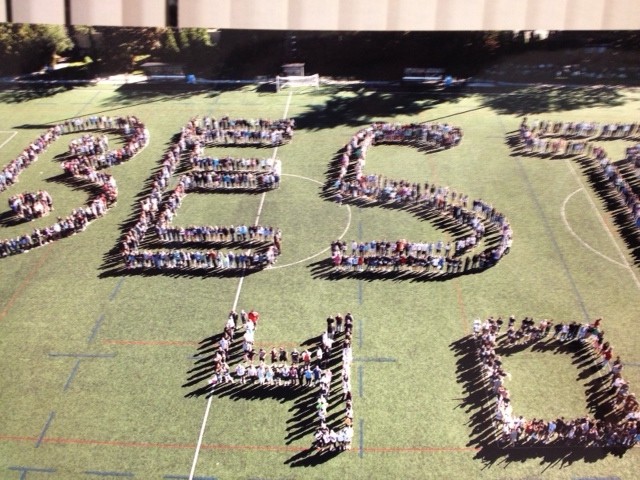
To commemorate the 40th anniversary of our school, we decided to take an aerial photo of our students on our field spelling out BEST 40.  We had a vision, and thought it was possible.  I contacted the News 1130 traffic helicopter and they agreed to take the photo.  Unfortunately the time they were in the air didn’t correlate with school hours so we went to Plan B.  I contacted the fire department and asked if they could use their Tower Truck to take the photo.  They agreed, assuming no emergency calls came in.  With vision and optimism, we thought we were ready.  I went to Costco and bought a gazillion roles of hockey tape to line the field before an assembly where we gave instructions on how to line up.   Sounds good right?  Well the logistics had some flaws.  Teachers called me over to tell me they had calculated the angle and that the photo would not work.  The hockey tape didn’t stick to turf, and to make matters worse the colour of the tape almost matched the field colour. Almost everyone suggested we just take one big group photo.  However, my principal and I had faith.  With completely inappropriate footwear for the weather conditions, we gathered five students to help us and we spontaneously used all the masking tape in the school to outline BEST 40. With minutes to spare, we led the assembly and our plan worked. The Tower Truck arrived, no emergency calls came in and we got our photo.  LESSON: Plan ahead but always believe in hope.

Mistake # 9 – Post It Note Chaos

Last June, I was approached by two of my leadership students.  They wanted to play a ‘grad prank’ that was safe and in good taste.  They had a vision of using thousands of coloured post it notes to line the lockers of the school spelling ‘GRAD 2012’.  They wanted to do this on a Sunday evening so the staff and students could arrive on Monday morning to find a colourful and tasteful surprise.  I agreed to meet them on Sunday night, so a group of 10-20 students could create their ‘art work’.  They brought in music, snacks and thousands of post its.  They got to work and I used the time to catch up on work in my office.  Life was going well until I heard banging from the floor above me.  I quickly discovered that the post it note prank had progressed into an out of control party of sorts. Students had let other students in, and not all of them had the same intention.  The pranks were no longer in good taste, and many other minor pranks were being arranged on each of the three floors.  I could not believe that I had essentially contributed to an event that had a negative impact on our school. I felt so much shame. Thankfully one of my friends on staff agreed to help me in the late hours cleaning as much as we could before Monday morning arrived.  Lesson: Kids will be Kids. Give them the wings to fly but not free reign of the school to plan a grad prank. 

Mistake #8 – Emergency Folder Updates

Every room in our school has an emergency folder with information, maps and paperwork necessary to help in an evacuation or emergency.  One particular day I decided to box up all the folders with all the updated inserts, and bring the box home.  The process of updating the folders took longer than I thought and I was tired.  My husband looked at me and said “what are the chances that you will need those tomorrow?”.  I agreed the chance was extremely low and decided to get some sleep, leaving the folders spread across my living room to be completed the following evening.  Of course, the very next day the fire alarms started to ring mid day and our school had to evacuate without signs, class lists, paperwork, etc.   Lesson:  Murphy’s Law Exists!  Be warned!

Mistake # 7 – The Big Drug Bust

Our school is right across the street from a big park full of trails.  It’s a beautiful setting, but also an easy place to hide.  I was well aware that one of our students was bringing drugs to school and selling them to others in the park.  However, I was one step behind him and never caught him in the act.  On a busy day, I saw him cross the road with friends and a big bag.  I checked to see if one of our other administrators could go for a walk in the park with me to see what we could discover.  They were tied up in meetings, but I didn’t want to let this moment pass by as I didn’t want our students smoking drugs in the park. I decided to linger behind the student group and enter the park alone.  In the distance I saw the person with the backpack head off the trail and head into the woods.  I decided I would out-smart him.  Instead of allowing him to see me coming down the same path, I decided to venture into the woods through a different direction so that we would meet up at the same spot.  I climbed over stumps, navigated tree roots and eventually came to the same clearing as the student with the back pack.  I said hello.  He turned around so we were face to face.  There I was staring at a man in his mid 40’s in the middle of the woods.  Hmmm.  Not so safe.  I quickly excused myself and exited quickly.   Lesson:  Safety First.  Plain and Simple. 

Mistake # 6 – Caesar Salad for All 

In preparation for parent night, and a staff dinner at the break, my principal asked me to pick up romaine lettuce at Costco.  I asked how much I should pick up.  She said four.  So off I went to Costco in search of lettuce.  I was delighted to find that Costco has already bundled the lettuce 4 / pack, so I picked up one pack and headed for the till.  Ten minutes before the dinner my principal asked me where the rest of the lettuce was.  I asked her what she was talking about.  Apparently she had meant four packages.  Who knew you couldn’t make salad for 80 people with only 4 heads of lettuce!  Now, most of you will probably think that I should learn something from this, but really, the lesson here is that we need to recognize the strengths in one another.  Funny how Mary never asked me to cook again.  Lesson: Know your strengths.  Cooking is not mine.

Mistake # 5 – Awards Night during Teacher Job Action 

Last June we had difficulty determining whether or not we should host our Awards Evening as the teachers were in Job Action and unable to volunteer their time to assist.  We decided that we would go ahead with a streamlined version.  Rather than having award recipients approach the stage one by one, we would call them up in groups based on the awards won.  Mark Rao MC’d the event, Mary O’Neill shook hands with the students and I distributed the awards and certificates from the table.  Minutes in I realized I was way over my head.  Students were approaching every second, and matching them with their awards in time for the photo was becoming an impossible task.  Deciding the show must go on, I continued to hand out awards and tell the students to smile. Only problem? The certificates did not match their names.  Each time I whispered to the student to see me at the end to swap the certificates.  At the end of the evening I remember Mark and Mary being pleased, and saying ” Wow – that sure ran smoothly!”.  I then explained that our blonde haired top Calculus student actually posed with the Korean student’s Drafting award with the wrong name, etc.  Good thing the camera didn’t have a zoom lens and no one noticed!  Lesson: The Show Must Go On! Smile for the camera, let the students shine and work out the kinks later.  Oh, and pray that Job Action will not return.

Mistake # 4 – Winter Formal Tickets

For years, our school has held a winter formal dance as a fundraiser for school clubs. Tickets have always been a hot item as the venue only holds 250 students.  In years past, students camped overnight to get tickets and then slept through or skipped class.  This didn’t seem educationally sound so we decided that we would sell tickets after school as a secret location within the building.  We decided not to announce the location until after our last class so that all students could attend school, and then have an equal chance of getting into line.  We asked one of our teachers to be near the secret location (at the end of a hallway) to help maintain an orderly line once the location was announced.  We picked our PE hallway as we have cameras in this location and we would be able to replay the video footage if students tried to sneak into line ahead of others.  Again, sounds like a good idea right?  OK – now imagine hundreds of students running full speed down the same hallway with one staff member trying to hold them back.  The video footage is priceless.  Imagine a mosh pit where the teacher, Dave Jones,  is all of a sudden crowd surfing with his hands flailing in the air as he is moved down the hall.  Sorry Dave! Thank goodness we moved to an internet based system this year.  Lesson: Embrace Technology and Avoid the Old Fashioned Line Up Craze!

Mistake # 3 – Fieldtrip Disaster

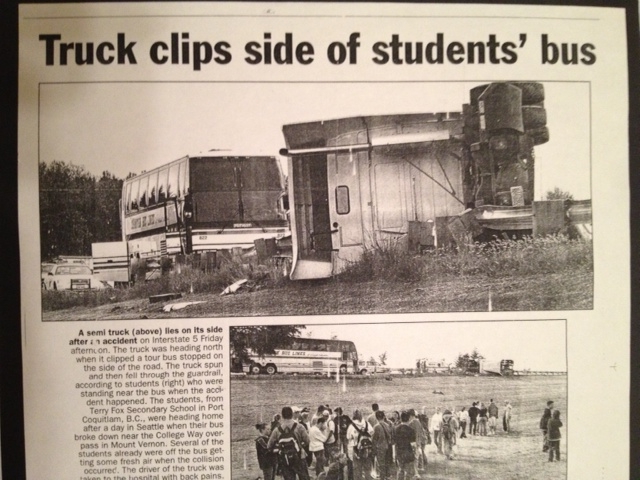
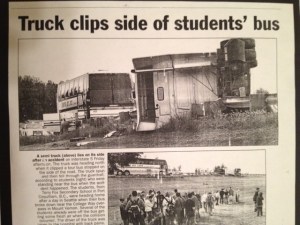
When I was teaching Marketing at Terry Fox Secondary, I arranged a fieldtrip to Seattle each semester.  We rented a coach bus to travel in comfort.  I did all the necessary paperwork so the office had all the student information.  Students had their ID, and we were ready to go.  However, on the way back home, our bus broke down on the side of the I-5 Highway near Mount Vernon.  The driver concluded the bus would not re-start and we started to unload.  This caused some traffic congestion in the area. Most of our students had moved to the grassy area beside the highway and the final six and the driver were in the midst of exiting the bus.  At that moment, a semi trailer failed to see the traffic stopping ahead, swerved to miss the traffic and instead clipped the front end of our bus.  The bus started to tip towards the kids and the truck flipped over the guard rail in front of us.bus accident  As you can tell by the photo, it is a miracle no one was seriously hurt in this accident.  However, when I phoned the school to inform parents and administration I realized the school was now closed and I didn’t have the contact numbers for our administrators.  Lesson: When planning fieldtrips, leave the necessary paperwork with the school, but travel with the necessary contact information to reach school staff and parents.
Mistake # 2 Hot Air Balloon

While working at Dr. Charles Best, I tried to come up with a creative idea each year to help raise thousands of dollars for the Terry Fox Foundation.  These included a ‘Kiss A Goat’ event, ‘Blue Devils on the Run Garden Gnomes’ and a ‘Hot Air Balloon Event’.  I approached Remax and asked them to donate their hot air balloon for our fundraiser.  They agreed.  We sold plastic balls for $10 each, and set a target.  The balloon operator then dropped thousands of balls from the sky, and the student with the ball closest to the pin won a $1000 cash prize.  The remaining funds went to the Terry Fox Foundation.  Again, sounds good right?  Over the past five years we have raised closed to $50 000 for the Terry Fox Foundation so I would consider this a success on many grounds.  However, when our event ended up on the front cover of the paper, a concerned citizen lodged a formal complaint with the BC Lottery Corporation.  In their eyes, we were teaching children, under the age of 19 to gamble, without a lottery license.  My apologies to the entire district who had to endure re-training on when and how to get a lottery licence.  Lesson: Be creative, have fun, help charities, but get a lottery license first!

Mistake #1:  Sandra & Samantha’s Reunion Twistsandra sam In 2009, we began Project HELLO, helping the homeless from the Downtown Eastside of Vancouver re-connect with family through Christmas Cards.  Sandra, pictured on the left, was the first woman to write a card.  When we found her daughter Samantha in Alberta they were both overjoyed.  Samantha had presumed her mother was dead, and was so excited to find out she was alive in Vancouver.  Neither had the funds to reunite, so our students and staff chipped in and paid for an all-expense paid trip for Samantha to come to Vancouver, including flights, accommodation and food.  After re-connecting them at the airport, we traveled in my car to the hotel.  Mid-route Samantha proceeded to tell the students and I that she would not be accepting the return flight, as she had decided to stay in Vancouver with her mom.  She shared a story about just getting out of jail in time for the flight as she had recently taken a Calgary city bus on a joy-ride.  Her children were no longer in her care.   Shocked and confused my mind was racing.  Minutes after dropping them off at the hotel, I was in contact with the Calgary police to discuss the situation. Samantha did decide to stay for a couple months and live with her mother on the streets of Vancouver.  This wasn’t exactly what we had pictured, yet when I look back, I recognize that it was still a beautiful act.  At the core, a mother and daughter were able to re-connect and share family stories, after a decade of not hearing from each other.  They may live lives that are very different from ours, but they love one another and deserved the opportunity to connect as a family. Lesson: Find the positive in each situation. Families come in many shapes and sizes, and helping them connect will never be wrong.

Above all, the most valuable lesson I have learned is that we have to take risks, seek new challenges and be comfortable making mistakes in order to grow and learn.  Oh – and in case you are wondering, I got the job!  Thomas Haney, I look forward to learning from my mistakes with you!

When the world says, “Give up,” Hope whispers, “Try it one more time.” 

The Power of Why: 101 New Year’s Resolutions

Maybe I’m feeling inspired from our recent trip to Disneyland, or maybe it’s the excitement I feel about beginning a new job next month, but as we begin a new year and I look inward to create meaningful resolutions, I find I am fascinated with the topic of creativity and innovation.

I have just finished reading The Power of Why by Amanda Lang and look forward to power of whyborrowing ideas from the book to spark creativity and innovation in our schools. As a child, Lang decided she wanted to be an architect. Her family supported her career goal and very early on she knew the steps to take to reach her goal. Unfortunately as she reached adulthood, she asked ‘how’ questions to reach the next step but didn’t stop to ask herself ‘why’. Eventually she realized that she had much more passion for the stories within the buildings rather than the buildings themselves, and she changed directions to explore a career in Journalism. All of a sudden all night assignments became invigorating rather than exhausting and she knew she was on the right path.  She now co-hosts the Lang & O’Leary Exchange CBC and is the senior business correspondent for CBC News.

While this book focusses most on the business world I believe there are many valuable lessons that we can take away and apply to education.

  • Shift our priorities. Rather than trying to develop creativity while meeting prescribed learning outcomes, what if creativity becomes an outcome itself?  Developing creativity as a learning outcome or competency allows us to remain curious, seek to improve, ask questions, and look at problems from new angles.  In essence, those who think creatively will continue to learn.
  • Find ways to preserve child-like wonder and reignite natural curiosity. In twin studies, research suggests that 80% of IQ is related to genetics but only 30% of our creativity.  This suggests that 70% of our creativity comes from environmental factors and can be learned. Unfortunately it can also be diminished if it is not encouraged.
  • Focus on the questions, not just a desired answer.  Promote questioning to develop divergent thinking.  A shift to develop a curious mentality versus an expert mentality allows students the ability to understand how they learn, and develops a skill set that will be beneficial in the future.
  • Look at education through the eyes of the customer.  Private schools do a great job at this, promoting their strengths and the benefits the customer will receive.  Unfortunately the public system often turns to the media to highlight what’s not working in schools rather than highlighting our tremendous strengths and opportunities as one of the best education systems in the world. To stay innovative, we need to continually improve while focusing on our strengths.
  • Reflect. If we want to be creative and curious in our work, then we need to start with ourselves.  People who have the courage to self-reflect and ask questions of themselves create opportunities for growth and positive change.  Lang warns that those who focus on routine and comfort may wake up one day only to recognize they are in the wrong career or wrong relationship.
  • Start with individual ideas and then work together. The most creative ideas develop when students have the time to brainstorm alone first and then bring their ideas to the group. Beginning as a group reduces creativity for a variety of reasons including self-censorship, groupthink, taking turns, laziness and a tendency to promote harmony over creativity.
  • We need to teach our students that one of the best ways to stay actively engaged in their learning when they feel they are losing focus is to stop and ask a question.  Students with ADHD have a natural aptitude for applying ideas from one topic to another – a gift in innovative thinking.
  • Shift thinking from ‘How’ to ‘Why’.  Rather than asking how we are going to accomplish our goals, or get our daily, monthly or yearly tasks done, stop and ask why.  Why do students and parents choose our school? Why do we do things the way we do? Often those who have lived in multiple countries or worked in various industries have a learned ability to ask why and look at situations with fresh eyes. Do we take time to stop and get the perspective from those around us?

So – as we enter a new year, I have decided to set resolutions from a different angle. Rather than asking what I want to do this year, I will look a bit deeper with each resolution and ask why. Gaining a deeper understanding of my goals will help me reflect on what I truly value and what I hope to accomplish. To set resolutions that matter, I plan to use a technique Lang describes that is used by many Fortune 500 companies to encourage innovation: Participants at creativity retreats are asked to generate a list of 101 goals. This seems like a rather long list, but the length has purpose as the goals that are harder to think of often require more stretch or deeper exploration into who we want to be. Goals that are further down the list are often more creative and unique.  Once completed, participants are asked to narrow their list to their top fifteen goals.  More often than not, goals near the end of 101 list make their way to the Top 15.

I am inspired by this idea, and will try this in order to set my New Year’s Resolutions for 2013. And like a child with natural curiousity, I will ask myself a lot of questions, understanding why and why not.  Although I have yet to complete this activity (that’s tomorrow’s task), I have a sneaking suspicion I already know one of my top goals for 2013….  I will awaken the three year old child within me and approach life from a curious perspective, not afraid to ask Why or Why Not.  As Lang concludes “asking questions makes life richer, more interesting, more fulfilling and more complete.  Better.  That’s the power, and ultimately the purpose, of Why”.

The Best of Best: Reflecting on School Culture

Since I began blogging, I have had many people ask me how I decide what to write about.  My answer is simple:  I wait until the weekend, and see what I am still thinking about from the previous week at work.  I use these lingering thoughts as motivation to write about what’s important to me.  It provides a way to reflect and it adds purpose to the work that I do as an administrator.  This week has been a particularly significant week for me, as I have just accepted a new position with the Maple Ridge School District beginning February 1st.  Although I am looking forward to the new challenge, I am also looking back, and reflecting on a great nine years at Dr. Charles Best Secondary.  As I prepare to leave, I feel the same way a parent must feel when they see their child go off to college.  Although I love my school, I am ready to let go, as I feel a sense of pride and confidence, knowing our school will continue to do great things.  When I think about what I am most proud of at our school, the answer is simple.  Our school culture. 

 This past Thursday morning, I experienced a serendipitous moment. I sat in  a district leadership meeting, listening to our guest speaker, Bruce Wellman.  I knew that while I was at the presentation, our principal, Mary O’Neill, was announcing to our staff that I was leaving.  I sat, reflecting on the past nine years, thinking about the growth I have seen at Charles Best with our culture.  Although the presentation centered on learning focused conversations, Bruce stopped for a moment and shared his simple idea for evaluating a school’s culture.  He suggested that the best way to test culture, is to walk towards the front door of the school with your arms full, and observe whether anyone goes out of their way to help you with the door.  This suggestion hit home for me, and  brought me back to my very first experience at Dr. Charles Best in June 2004:

I had just accepted a teaching position and I approached the school for the first time to set up my classroom.  I was seven months pregnant, and wanted to get the room set up for the fall semester so the TOC would be off to a great start.  With my pregnant belly protruding outwards I somehow balanced a relatively large box of materials and walked towards the front door.  Just before I reached the door, a teenage boy ran towards me.  Instantly I was overwhelmed with appreciation thinking to myself “WOW – what a great school… this boy sees that I am pregnant and my hands are full and he wants to help.”  I smiled and waited to hear “let me get that for you.”  Instead, I heard “excuse me… could you tell me what time it is?”  Apparently it did not cross his mind that it would be very difficult for me to check my wrist while holding a large box.  I apologized for not knowing the time and he ran the other way. 

Now, before I offend the students from 2004, I am certain that many students would have helped.  However, it did leave a lasting first impression of the school culture.  And, when I think of where we are at now, I can say with absolute certainly that our culture has evolved.

 When I think about our current culture, there is so much I am proud of.  Here are just a few examples of what I consider The Best of Best.

 Heart:  Our school has heart.  In fact, it really defines how we do things.  Our staff love our students, and our students continually tell me they love their school.  We do not have very many policies.  In fact, the only rule we constantly reinforce, is a rule of respect.  When respect is broken, our goal is never to focus on punishment. Instead, our counsellors, youth workers and administration always take a restorative approach where the consequences allow the student to reflect, take responsibility and learn from the experience.  We often ask “how can the individuals who have caused harm repair the relationship and return with new skills to help them in future situations?”   Our school shows heart in everything we do, from the way we treat each other to the way we interact with our local and global community.

Community:  Our school does a fantastic job of giving back to the community.  Our French Immersion students work with KIVA helping entrepreneurs in third world countries, our leadership students volunteer regularly in elementary classrooms, our Tech-Ed students help with community projects such as the kitchen renovation at the women’s shelter and rebuilding structures in community parks, our Home Ec classes prepare meals for the homeless shelters, our Best Buddies offer local babysitting nights and volunteer throughout the community, our Schools for Schools team teaches parents about social media, and our Project HELLO team helps the homeless reconnect with families.  At Christmas time, students and staff join together to prepare hampers for those in need and throughout the year we work together to support charities. 

 Mentorship:  Our school has an incredibly safe feel to it, and I believe this is a reflection of the excellent mentorship that occurs for both students and teachers.  New staff are welcomed to the school, and teachers show a willingness to share resources and find ways to learn together.  Recently our staff created a ‘Best Practices’ list centered around mentorship so we can support teachers new to our school.  Similarly, our incoming grade nines are each assigned a Best Buddy as a peer mentor to help them with their transition to high school.  Our new cross grade advisory model and our incredible peer tutoring structure allow for students to continually learn together and support one another at different grade levels.  Students exploring a passion beyond the prescribed learning outcomes are encouraged to do so through IDS courses, working with a teacher mentor. 

 Professional Learning Community:  Our teachers model a love of learning.  Many of our teachers have achieved or are pursuing masters degrees.  Many participate on district or school learning teams, and all participate in formal and informal meetings collaborating and sharing ideas.  Our teachers continually find ways to learn through professional development, and to give back by presenting, sharing with others or helping to create new resources. On Tuesdays, teachers get together for ‘Tech Tuesday’ and learn the latest technology tips from one another. Our librarian has designed an online library system where students and staff can learn at anytime from anywhere. 

 It’s Cool to Learn:  Our Math Camp is the best example of this.  Our math students volunteer their time to create fun engaging math camps so that middle school students can come to the high school and do math together.  And, they do so with such passion and excitement, that the camps actually sell out.  On the weekend…….  So just to say it again, they convince pre-teens to give up their weekend to do math for fun.  Now that’s a cool accomplishment!

 Acceptance: Every student matters at Best, and all of our students who face learning challenges are fully supported and accepted.  Our skill development students are integrated into our classes, and they become mini-celebrities once a month when they host  ‘Sugar Shack’ events, where they open up a bakery for the rest of the school. Our Learning Resource Centre and our Student Learning Centre offer assistance to students requiring adaptations and modifications.  These programs help students advocate for themselves and develop their skills in time management, organization, reflection, and studying. Students gain confidence in themselves and develop a greater understanding of how they learn.

 Participation: Almost every student at Best gets involved with a club, sport or activity.  From the Fine Arts, Athletics, and Service Groups, our school really has something for everyone.  We have over 50 sports team and clubs, and we always let the students know that we are willing to sponsor new clubs if the students are interested.  Some of our newest clubs include a photo club, a book club and a toastmasters club.  Our sports teams continue to excel winning district and provincial titles (though I have to admit this absolutely has nothing to do with me as I am SO SCARED OF THE BALL…. I really don’t understand why so many people like having projectiles thrown at them… .but that’s another blog all together).

 Growth: Perhaps what I like best about our school, is the willingness to try new ideas. In my time at Best, I have always felt supported and encouraged to think outside the box and make new suggestions. Creativity is encouraged, and programs are developed based on the needs of students.   As we integrate technology, and re-think our learning model, we do so with a focus on student learning, and an open mind.  When we look towards the future, we ask ‘What if?’, and we allow each other the chance to dream about the school we want to create. 

 And so, nine years later, as  I prepare to leave Charles Best, I do so with confidence, knowing that our school is a wonderful place to learn, with a rich culture that passes the test of Bruce Wellman.  I smile, knowing full well that when a new Vice Principal arrives with boxes in hand, someone will be there to open the door.

Change Your Perception… Change Everything

It has been said that if you can change the lens through which you view the world, you can change your reality.   The famous image below is perhaps the best example of this:  to some, this picture shows a beautiful young woman with a feather in her hair and a black necklace.  Others see an elderly woman in a thick fur coat.  With intention, we can allow our mind to look at this image and see it both ways. 

young-woman-old-woman-illusion

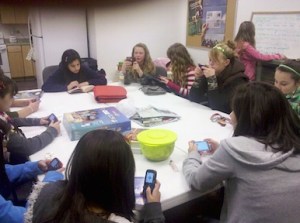
Our perception, is shaped by our upbringing and our past experiences.  Depending on what we value and what we assume, we are able to judge a situation and form an opinion about what we see. Have a look at this next picture and think about what you see.

 cellphones

Perhaps when you looked at this picture you saw students off task, distracted by their phones.  Or, conversely, perhaps you saw students embracing technology and using one of the functions on their smart phones as a learning tool.  Regardless of what you saw, I think it is important to note that it is very plausible that others saw it differently.   Recently, I have found myself in a couple of situations where I recognize that the use of technology creates different perceptions, depending on the lens through which it is viewed.  Here are three examples:

After a recent professional development workshop, I met with a teacher on staff who was quite disappointed about the level of respect our audience showed the speaker.  When I dug a bit deeper, I discovered that this particular teacher considered it very rude to type on a computer during someone’s presentation.   I then suggested that teachers may have been using their computer to take notes, as that is what I had been doing.   This was a shift in thinking, as this particular teachers saw the audience members with paper and pen as ‘on task’ and those with computers as ‘off task’.   Personally, I am intentionally trying to make an effort to use less paper and write notes on the computer as much as possible.  However this conversation helped me recognize that the use of technology may need to be addressed in the ‘housekeeping’ details at the beginning of a workshop or meeting so there is shared belief around whether or not it is appropriate to use technology.  At the most recent conference I attended, they encouraged the use of social media and created hashtags so conference delegates could share thoughts and add to the conversation through Twitter.  However, for those viewing technology as a distraction, this creates a very different image.

These instances occur in the community as well.  One of my friends is a hockey coach for his son’s hockey team.  He uses his cell phone as a stop watch to record playing time of individual players.  Mid season he received a complaint letter from a parent claiming that he was not focused on coaching as he was on the phone the whole time.  Again, depending on the lens you use, you can either see this situation as a ‘coach actively finding ways to give every child play time’ or a ‘distracted coach who is on his phone during the game’.  I’m sure the parent would have had a different perception if they saw him holding a stop watch.  Sometimes we need to recognize that our perceptions shape our reality, and that our assumptions are not always correct. 

In a third example, I had an hour to kill in a pediatric dentist office while I was waiting for my son.  As I looked around the room, I noticed every parent was actively engaged with their cell phone.  I sat looking at the room wondering what a passerby would think.  Would they see parents distracted by their phones?  Would they think the same thing if they walked by and saw parents flipping through books or magazines in the waiting room?  I recognize that phones have so many functions, and there is no way of knowing what the parents were doing.  Perhaps they were creating shopping lists. Perhaps they were reading e-books, perhaps they were using the internet, or answering emails for work.  And, of course, there is a chance they were filling their time playing Angry Birds. 

Regardless, each situation reminds me of the power of perception, and that as technology changes, we need to be aware of our own judgments when we see someone focused on their ‘smart’ phone.  If we rewind five years, we were quick to prohibit cell phones and pagers in class as they disrupted the learning environment.  Now, phones are capable of so much more, and many schools have moved to a ‘BYOD’ or bring your own device policy, as phones have the ability to enhance learning, if used responsibly.  If we recognize the potential good of cell phones in the classroom, then we have successfully shifted our thinking, and changed our reality. 

Similarly, security systems are primarily used to capture negative events.  However, what they really capture is a snapshot of reality.  As this uplifting video recognizes, it is up to us to determine whether we want to see the positive or the negative.  And most importantly, it’s a great reminder that we have the ability to shift the lens through which we see the world.   Our perception is our reality.  Change your perception… change everything.

Everyone Has A Story… Looking Beyond Addiction

This morning I had the opportunity to attend a great presentation in Maple Ridge with Dr. Gabor Mate, physician and bestselling author on addiction, attachment, parenting and mind-body wellness.  Dr. Mate began his presentation talking about addiction and the Downtown Eastside of Vancouver.  He expressed concern for society’s understanding of addiction, explaining that our current system assumes two theories of addiction: the first that addiction is genetic, or the second suggesting that addiction is a choice people make.  What he stressed is the convenience of these theories, for as long as we support them we negate the role society plays in the lives of people struggling with addiction.  He encouraged the audience to look beyond the addiction, and ask “Why the pain, rather than why the addiction?”  Through his work on the Downtown Eastside he has come to realize that addiction is often a result of impaired attachments.

Dr. Mate’s presentation was a good reminder for me, as I often have the opportunity to talk to students about drug use. While some students try drugs for experimental reasons, I would say it is more common for students to turn to drugs as a way of medicating their own stress.   I am grateful that our district has an ‘alternate to suspension’ program to address drug use in students, offering counseling services and goal setting.  I am reminded to ask questions, get to know students, and dig deeper to hear the life stories, and stresses that may be masked by drug use.  Once we can determine the cause of pain, we have a much greater success of helping the student heal.  Research indicates that a connection to family and a connection to school are the two most significant factors determining whether a student will engage in problematic drug and alcohol use.  When students struggle with drug use, I need to remember that a suspension is a consequence but not a solution.  Taking time to get to know the student and helping them find ways to connect with the school will have deeper impact.

Dr. Mate’s presentation this morning also reminds me of a friend I lost a couple years ago, when he passed away from addiction issues.  Irvin Wickens became a friend, in the most unlikely of circumstances, and he left me with the most meaningful gift I have ever received.  

 Here is the story of my friend, Irvin Wickens…


In November of 2009, a church in Port Moody approached our school and asked if we could advertise a volunteer opportunity for our students to work in the local homeless shelter, providing dinner and conversation.  The response was overwhelming and we have over 100 students wishing to participate.  We committed to two shifts per week, where I would volunteer with 6-10 students and staff.  

 Our first night at the shelter was November 13, 2009.  It was a cold, wet, rainy night where we served chili and buns to provide some warmth to the twelve clients at the shelter.  As we served dessert, a student and I sat down beside Irvin.  Irvin had the stereotypical image of a homeless man: his clothes were worn and dirty, his hair unruly, and he was unshaven.  Yet beyond that his eyes sparkled, and he offered kindness and gratitude as we engaged in conversation.  Irvin told us that he it was his mom’s birthday.  I asked if he had had an opportunity to call her.  He told me no, as his mom had passed away years ago.  He also shared that he had lost two sisters.  Assuming they had died recently I asked him when they had passed away.  Irvin then began a story I will never forget….  he spoke of his childhood in Milwaukee, and a horrific night when he was just six years old.  Living in poverty, with a single mom and three siblings, he awoke to find their house on fire.  Irvin woke one sister who shared a room with him.  He then ran across the hall to try and get to the room his other two sisters shared.  The fire blocked the entrance so he ran to wake his mom.  He shared his memory of his mom running into the fire trying to save her daughters.  He then recalls his images of his mom emerging from the house covered in burns and overcome with grief, as she whispered ‘they are gone’.  In that moment, Irvin lost a 3 year old and 8 year old sister.  Trying to hold back my own tears I told Irvin he was a hero for saving his mom and one sister.  He then politely excused himself to go for a cigarette and I excused myself to tidy up the dishes.  In that instant, Irvin taught me that homelessness is not caused by addiction, but rather by trauma and an inability to move forward.

As I waited with our students for parents to pick them up that evening, one student who had heard Irvin’s story approached me and told me that he had been struggling for months with the news of his parents’ divorce.  After hearing Irvin’s story, he realized he still had two parents that loved him and he needed to stop feeling sorry for himself as his problems were minimal compared to Irvin’s. 

For the next year, we enjoyed our weekly visits with Irvin.  His eyes would sparkle as he would speak of his adventures in life, and on a good night he would break out in song and amaze our students with his beautiful voice.  Tears would roll down his face as he would sing Eric Clapton’s ‘Beautiful Tonight’.  When he finished his dessert, and left the table, he would always shout out with enthusiasm “Cowboy Up!”

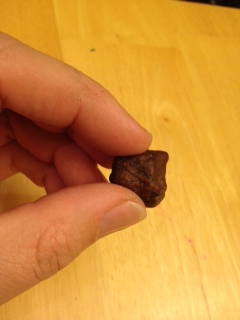
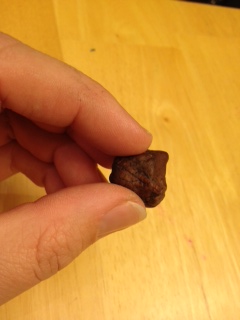
In late March 2010, I had a great conversation with Irivn about what he would do if he won the lottery.  He spoke of all the charities he would help as he appreciated the help he had received from others and he wanted to pay it back.  On our final evening at the shelter I approached Irvin and told him I had a gift for him.  I gave him a lottery ticket and told him I hoped his luck would change.  I thanked him for sharing his story and for making such a difference with our students.  Irvin reached in his pocket and told me he had a gift for me as well.  Not knowing what to expect from the pocket of a homeless man, I remember feeling nervous about what could possibly come from his pocket.  When he unfolded his hand, he held out a small brown rock.  He told me that the year before the shelter opened, he was living under a bridge in Port Coquitlam.  Some middle school students had approached him with their teacher and offered him some cookies.  With the cookies, they had also given him the rock, and told him it was a friendship rock.  They asked him to keep it in his pocket, and to remember each time he felt it, that the community cares about him.  Irvin told me the lottery ticket would replace the rock, and he asked me to take the rock, and put it in my pocket to thank me for caring about him.  Eight months later, Irvin passed away from his addictions.  However, his story, and his rock, will be with me forever. 

Dr. Gabor Mate’s message, and my friend Irvin, teach the same valuable lesson.  Everyone has a story and we need to look beyond addiction to discover the root of the pain. Love, compassion and connection will always be more powerful that punishment and shame.

Cowboy Up!

Teeter Tottering with Balance

It’s Monday afternoon, all of the neighbourhood kids are curled up on our couch watching a movie, and I’m feeling rejuvenated after a great four day weekend.  I made the conscious decision to ‘not work’ for the four day weekend, and spend time focusing on family, friends and the to-do list.  It’s amazing how much we were able to get done with an extra two days off.  The house is clean, groceries bought and we had the opportunity to enjoy some family time, outdoor walks, some Christmas shopping and a date night.  We also finally found some time to develop a workout schedule to get our fitness routine back on track.  Since I declared this a ‘no work’ weekend, I had initially planned to take the week off blogging as well, however I thought I would write a few words about balance, and what it means to me, as it has been on my mind this weekend.

From the outside, I’m willing to bet that many people do not see my life as ‘balanced’.  I work long hours and have two young children at home.  However, I also have a fantastic husband who works at our boys’ elementary school as a Special Education Assistant so he has the ability to walk to and from school with our kids.  He is able to do the regular morning routine, pack the lunches and juggle play dates and after school activities.  We are also blessed with two amazing sets of parents who want to play an active role in our kids’ lives, and offer to take care of them or take them to activities as much as they can.   For us, our schedule works.  Some weeks are crazier than others, and many days I arrive home minutes before my husband has to leave for soccer practice or a shift at his second job at the Fire Hall.  However, our schedule works for us and we all enjoy what we do.   

I know that I am very fortunate to have the support system I do to let me work long hours when needed.  I know that my kids are growing up in a rich environment surrounded by people that love them.  When I think of my own childhood, I was fortunate to have a similar situation.  Although I grew up in a single parent home, it did not feel that way as my mom’s extended family was always there.  I had an amazing relationship with my grandparents and did not feel I missed out despite my mom’s busy schedule.

It’s interesting how many comments I receive from others about my job.  People make comments all the time about the ‘time away from my kids’.  When I decided to apply for an administration position, many people suggested I should wait until my kids are older.  I often wonder if men in the same position get these comments.  Maybe.  Not so sure.  Last month I had someone come up and tell me that I should not be blogging because I was taking even more away from my kids.  I found that really interesting.  Would the same person think critically if I had said I watched TV after my kids went to bed?

You may wonder why I started this blog talking about balance only to defend my busy schedule.  Well – after spending four days re-charging, I have come to realize that balance means something completely different to each individual.  Balance is something that cannot be prescribed but rather something we can obtain when we get to know ourselves well and understand what we need to bring out our best self.  Some workshops on balance will use a balance wheel to help people recognize the commitment they are making to different areas of their life ranging from spirituality, career, relationships, exercise, mental health etc.  However, my experience has been that everyone leaves these workshops recognizing that they are not doing enough in at least one area of their life.

This weekend, when I thought about balance, I realize that I do not see balance as a wheel, but more like a teeter totter.  For the teeter totter to work, I need to balance the two sides: my personal and my professional lives.  The centre is made up of who I am and what I value and it keeps the teeter totter together.  If I put too much weight on either side, the other side becomes off balance as well.  I know that I have often said I am a better mom because I work (and I don’t mean to judge stay at home moms at all…. In fact, I give them credit because I have no idea how they do it! That really is the hardest job in the world!).  I have also come to recognize that I am a better vice principal when I spend time with family.  Time together nurtures my soul and recharges me.   When the two sides are balanced, both sides take flight and the teeter totter works.  Sometimes one side is higher than the other, but in general they work together to create balance. 

Just like a teeter totter, when I put too much weight on one side, I don’t get better at what I do… instead I eventually hit the ground.  This is true with both my personal and my professional life.  My husband will be the first to admit that I start to act a bit nutty by the end of summer.  After re-organizing closets and paying way too much attention to minor details of life, it is definitely time for me to get back to work.  Similarly, when work gets crazy it’s important for me to remember that putting too much time in, doesn’t really help anyone, as really it just leads to an eventual crash where one side hits the ground. To make good decisions, I need to maintain a sense of balance.   I know that when I take time to run or workout, I go to work with more energy and a more positive disposition.  When I schedule ‘downtime’ and turn the computer off for a weekend, I am able to feel recharged much more so than a weekend where I am sneaking work in at night.  I need to recognize that my job will never be done, so choosing to stop working needs to be a conscious choice.   I once heard someone say that every time we say yes, we are saying no to something else.  This has stuck with me and I often ask myself what I am saying no too.  I try not to say ‘no’ to my family more than I need to.

Chris Kennedy, Superintendent of West Vancouver, recently wrote in his blog about President Obama.  President Obama has made the conscious decision to try to be with him family by 6:30 PM each night.  Upon reflection, Chris recognized that if the president can reach this goal more nights than not, then a superintendent of schools should be able to do the same.  I admire this goal, not only because it allows for more time with family, but also because it sends a positive message about leadership.  I think it is important to model what we expect from others.  If we don’t want students and teachers working around the clock at the expense of their personal commitments, then I believe it’s important to model the same.

Perhaps what I recognize most about balance is that each of us is very different, and has different needs to be our best selves.  For one person, balance might mean staying at home to raise children, and for others it might mean working part time.  For some, depending on personal commitments and their stage in the life cycle, balance may be possible while working over sixty hours per week.  Balance cannot be prescribed because there isn’t a formula that works for everyone.  However, I believe each of us should take time to reflect on what we need to achieve our best.  For some yoga and a good book sound appealing while others prefer the adrenaline rush that comes from extreme sports or roller coaster rides.  The activity itself is not important, but rather the outcome.   Recognizing what makes us feel alive helps us discover what we need to nourish our spirit and reach our personal sense of balance, rather than conforming to others opinion of what balance looks like.  Balance comes in different shapes and sizes.  So dig deep, figure out what you need to take flight and let both sides of your teeter totter get some air.