Teens, Teachers and Social Media: Same Tools, Different Purpose

This school year I decided to develop my personal growth plan around technological literacy.  I did so for a number of reasons:  First, I was hearing from our students that they were using Facebook less than in the past, but their use of Twitter was on the rise.  I had no idea how to use Twitter at the time, and I was not comfortable knowing that our students were communicating in ways I did not understand.  For years I have used Facebook as a way to communicate with students, post information about school events, and stay up to date with issues impacting our students. If our students were switching to Twitter, I wanted to learn so I could stay connected.  Second, I wanted to explore how the use of blogging and social media could improve learning, professional development, communication and reflection.  I wasn’t sure what to expect….

Eight weeks later….

To be honest, it feels funny to type ‘eight weeks later’ because I can’t believe that two months ago, I did not embrace social media and blogging the way I do now.  It reminds me of the Buddhist Proverb, “When the student is ready, the teacher will appear.”  Both Twitter and blogging have re-shaped the way I learn and reflect.  Twitter is one of the best mediums of professional development I have ever experienced.  It allows me the opportunity to share ideas, engage in professional dialogue and learn from students and educators around the world.  And the best part? It takes place anytime, anywhere, and it’s free.  Similarly, I absolutely love taking time each week to blog.  Some people have asked if it feels like one more obligation competing for my time.  The answer is a definite no. In fact, it has the opposite effect.  The commitment to blog is a commitment I have made for myself reminding me to take time to slow down and reflect, and to focus on what I am learning, rather than getting consumed by the never ending to do list.

The second lesson I have learned since the start of the school year, is that I do not use social media the same way our students do.  I adopted Twitter to understand student behaviour, but instead I ended up on a professional development journey.  Knowing that our students were not all using Twitter to read articles and share ideas around the world, I decided to host two events with students to better understand how they use social media.  First I hosted a focus group with a small group of students from grades 9-12.  Second, I invited some students I didn’t know well to come in for a working lunch…. we provided lunch and they taught our admin team and youth worker how teens at our school are using Twitter, Instagram, Tumblr and other social media sites. 

It is important to note that the observations I have made do not necessarily represent how all students use social media.  Nonetheless, the students I spoke with offered some interesting insight.

Facebook:  Facebook is used by most, to post pictures, comment on friends’ status updates and stay connected with friends.  Most of their parents also use Facebook or feel that they understand Facebook.  However,  many students shared that it is quite common for teens alter the privacy settings so their parents only see parts of their Facebook page.  Similarly, some students admit to having two Facebook profiles…. one their parents know about, and one they don’t.   Most of our students felt that Facebook enhanced their learning in many ways…. they use Facebook to form study groups, to upload homework files, and to stay connected with meeting times and practice schedules for extra-curricular commitments.  Almost all students also have Facebook on their phone so they receive alerts as new messages arrive in their Facebook inbox.  Most students noted that they are always on facebook while doing their homework, allowing them to collaborate, ask questions, or just chat.   At our school we post many of our school announcements on Facebook.  We now have over 800 of our 1300 students connected to our school Facebook page.  When we need students to sign up for something we post it on Facebook and we have responses in seconds.  The speed is almost instantaneous, and much more effective than using PA announcements that often get missed.

Twitter:  Many students told me that they use twitter to ‘vent’ or to express emotion.  They create hashtags that match their emotion and have conversations about how they feel about something or someone.  Most felt that their parents do not know how to monitor their use of Twitter.   Many explain that their general conversations with friends have switched from Facebook to Twitter.  Twitter appears to be the platform with the greatest opportunity for learning.  A teacher can use Twitter to have students tweet answers while in the classroom or from home, and students can connect with other classes around the world engaging in conversation, learning with one another.

Tumblr:  I have to admit, I still don’t really get this one.  Many students use it to upload photos, and comment on each other’s pictures.  They also use it as a blogging tool.  Tumblr seems to be more popular with our younger grades than our senior students.  What many like about Tumblr is the ability to post and receive anonymous comments.  As a past school counsellor, this is what I really don’t like about Tumblr.  The anonymous feature allows people to say things they would not say with their name attached.  Students mentioned that Tumblr is useful for school projects on teen issues such as eating disorders, depression, etc.  Searching on topics such as these leads to teen pages with blogs and photos, giving the student an understanding of how other teens are thinking. Many also shared that this is a platform where they post positive messages to support one another.

Texting: Our students shed some light on how texting impacts student to student relationships.  From my ‘old person’ perspective, it seems like texting has replaced old school flirting.  Unfortunately, it seems like younger girls sometimes feel obligated to engage in very private conversations or photo sharing because they believe a genuine connection exists. When relationships don’t develop further, or teens break up, some girls mentioned feeling regret around the information they have shared through their phones. Again, this seemed to be more of a concern to our younger students in grades 9 and 10.   This conversation gave us insight to the importance of education around healthy relationships, and the importance of conversations with both our male and female students about appropriate use of technology.  With the average teenager sending and receiving over 3000 texts per month, we need to provide education on how to embrace digital communication in a responsible way, fostering the same sense of citizenship that we expect in face to face interactions. 

I am thankful to our students for taking time to engage in conversation and allow me to understand social media through a different lens. Our students are growing up with technology and they have much to teach us when we give them the opportunity to do so. As I continue on my own personal journey with social media, I am mindful that our students may use the same tools, but in different ways.  And no matter how much I learn with social media, I am again reminded that the best way to connect with our kids will always be face to face conversations.
Lessons of Hope… Project H.E.L.L.O.

If I rewind five years, I recognize that the anticipation of the Christmas season was something I marked with commercial milestones such as the arrival of Costco’s Christmas aisle or the transition from white to red cups at Starbucks.  Three years ago, in December of 2009, my students taught me the true meaning of Christmas. 

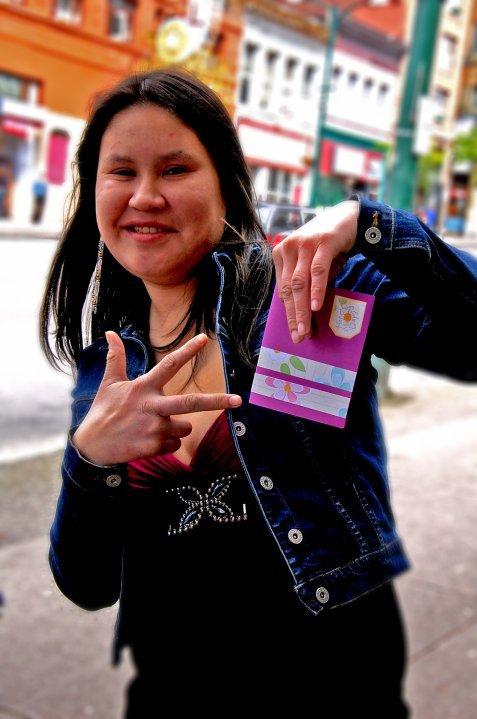
Our story began when a group of Best Buddies (our extra-curricular leadership students) asked if we could incorporate some visits to the Downtown Eastside as part of our leadership program.  Our intention was to visit Hastings Street during the winter season and hand out food and clothing.  A couple weeks before our visit I read an article in the Vancouver Province debating the merits of the social programs on the Downtown Eastside (DTES), questioning whether they helped or enabled the lifestyle.  I sat wondering what it would be like to rely on handouts and I thought about the reasons we wanted to help.  Recognizing that our students gained so much by giving, I began to question how we could give the homeless community the power to give during the Christmas season.  I met with the Best Buddies, and suggested we make some handmade Christmas cards and offer the homeless community the opportunity to send messages to friends are family.  Luckily our students embraced this idea and eagerly made our first cards.  We assumed that many people would take the cards and give them to friends living in their community.  We hoped that one person would decide to write to friends or family that they had lost touch with… but we had no idea what to expect.

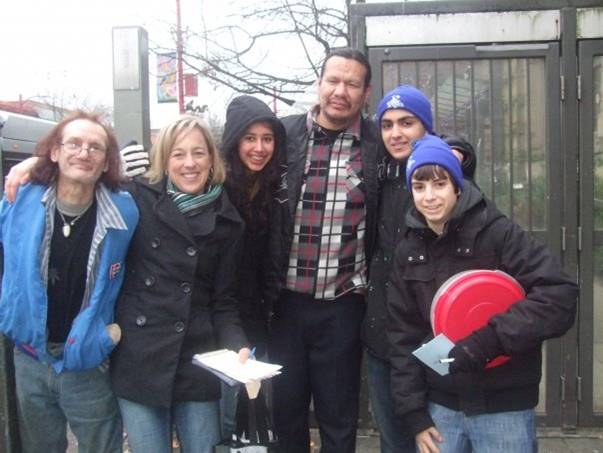
During our first visit, I headed to the DTES with three students and a handful of cards.  It was late November and Christmas wasn’t really in the air, especially on Hastings Street.  Cautiously, and somewhat awkwardly we initiated our first conversation with a woman named Sandra who stood in the cold leaning against Carnegie Centre. We asked if she would like to write a Christmas card to any friends or family.  She smiled and asked if she could send two.  She had limited dexterity and asked the students to write for her. 

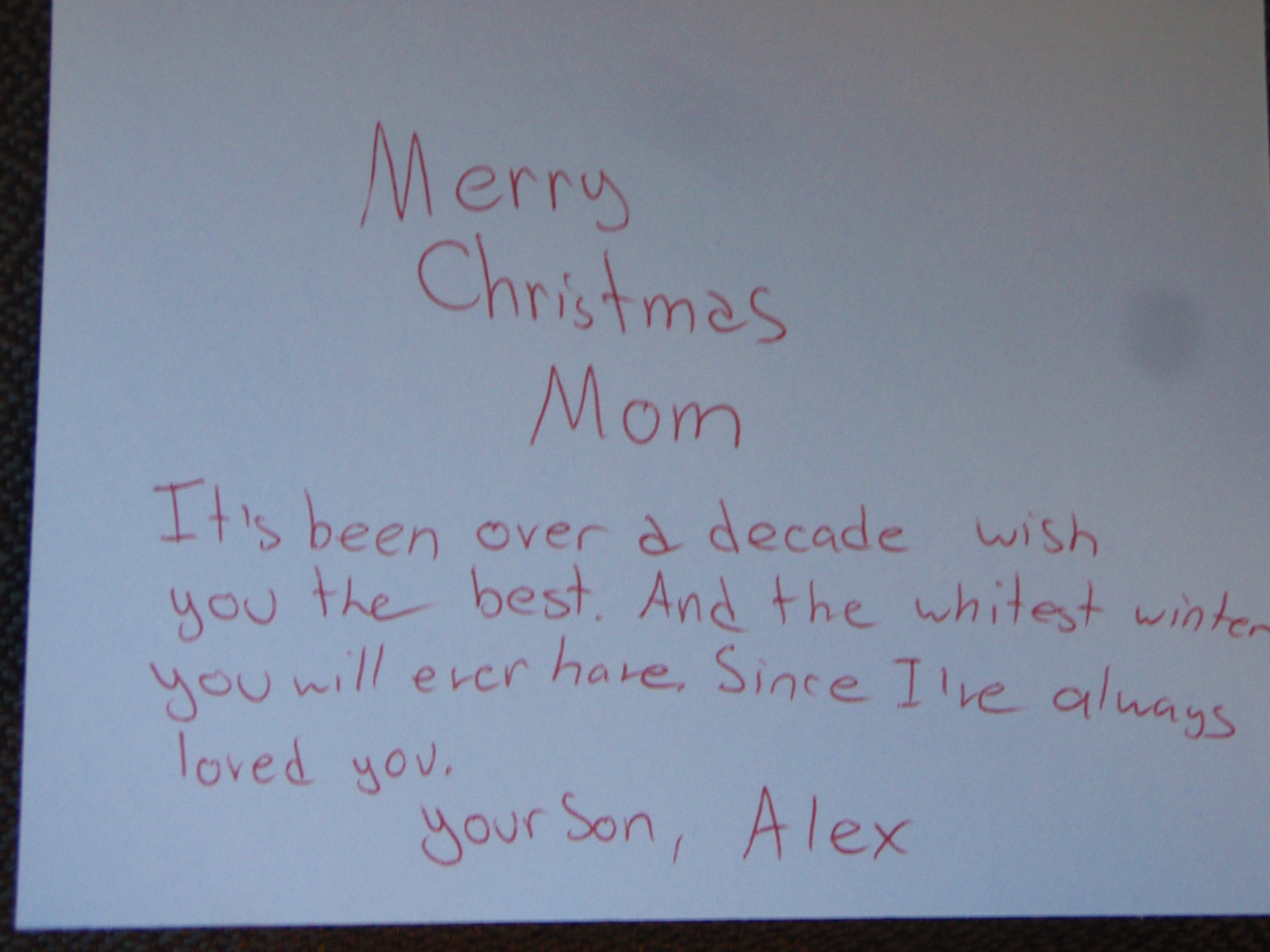
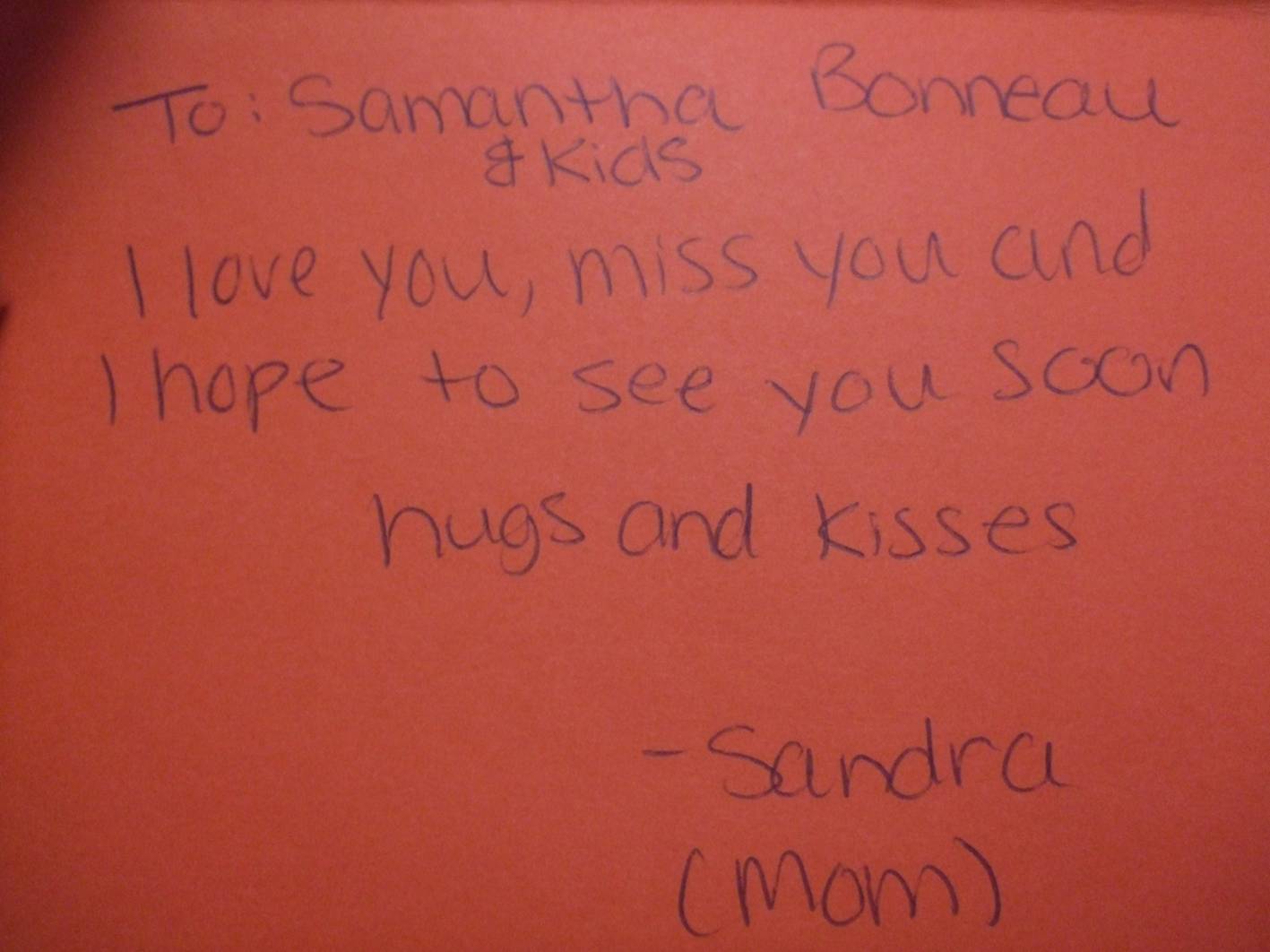
Sandra chose two cards.  The first one was for her daughter Samantha who she had not heard from in ten years.  Last she had heard, Samantha had two children and was living in Alberta.  She wondered if Samantha had more children now.    She also wrote a card to her mom Noelle, wishing her a Merry Christmas.  We promised Sandra we would do what we could to track down her family and mail the cards on her behalf.  That afternoon, we left the DTES full of hope, as we had met seven people who had reached out and opened their hearts sending Christmas wishes to family they had lost touch with. 

The next day, students met in my office and we started to search the internet for possible phone numbers.  The first calls we made were to Alberta, searching for Sandra’s daughter.   On the second call, a woman answered and let us know her roommate Samantha was at work.  We explained why we were calling only to learn that Samantha had assumed her mom had passed away after searching for her with no success.  Samantha reached us, ecstatic to receive the card and learn that her mom was OK.  She wanted us to let her mom know she was OK, and to let Sandra know that she had four grandchildren. She also asked us to tell Sandra that her mom Noelle had passed away six weeks before our call.  We knew we had to go back and find Sandra again…  and we knew our project had just become so much more than a one day fieldtrip.

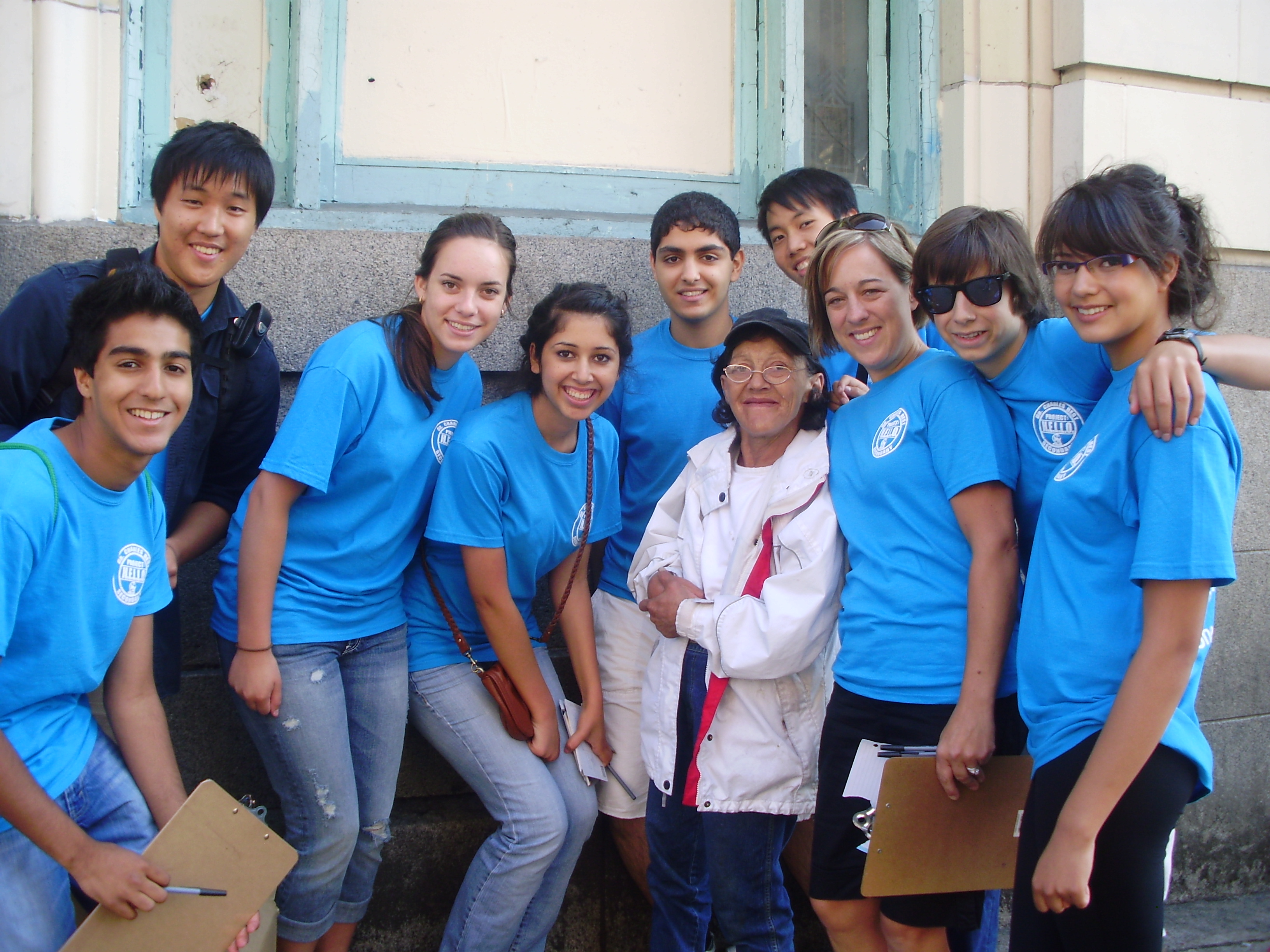
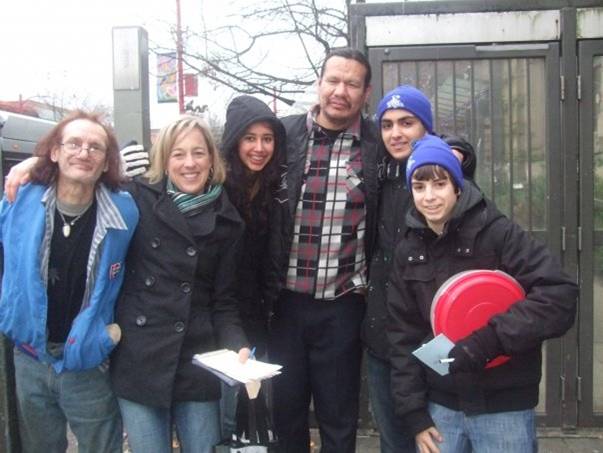
We began to call our project ‘Project H.E.L.L.O.’ which stands for helping everyone locate loved ones. During that first season we took five trips to the Downtown Eastside.  Word of our project spread through the media, igniting a fury of activity as citizens across the province wanted to help.  Our students spoke to newspapers, radio and TV networks, sharing our story but also sharing names of people we were looking for.  All of a sudden we had people who offered to help: community centres, pharamists, small town post offices, the BC Housing Commissioner, and compassionate citizens.    From our first seven cards, we were able to find 5 of the families.  We had set out hoping to help the homeless but we quickly learned that we were the ones gaining so much.  We had never anticipated what our project would mean to the recipients of the cards, and we had not expected to hear so many personal stories about families impacted by poverty, drug use, mental illness and homelessness. We were so inspired by the lessons we were learning.

Although school let out for the Christmas break a week before Christmas, our students did not leave.  They searched the internet, used the phones, made connections and mailed cards right up until December 23rd.  On Christmas Eve we realized we all had shopping to be done, but the commercial side of Christmas just seemed so irrelevlant compared to the gift our students were giving these families.  In our first year, we were able to make 74 connections sending hand crafted cards with messages of love to the families of people on the DTES.  We searched for ways to reflect on our project and provide appropriate closure.  The message back from our students was loud and clear.  They did not want a wrap up event, instead, they felt this was just the beginning.  They asked if they could go back to the DTES and host an event sharing the stories of the connections they had made.  Our students wanted to find a way to express their gratitude to the homeless community for trusting them with their stories, and welcoming them into their lives.  The students hosted a gratitude event on Hastings Street and an evening of reflection for our school community.  They also decided to write about their experiences in a book entitled ‘Lessons of Hope: Rekindling Relationships and the Human Spirit in Vancouver’s Darkest Neighbourhood’. (This can be read online at http://www.bookemon.com/book_read_flip.php?book_id=78640&size=1.4&style=popup2)

In the spring of 2010, we received an email from Hawaii.  Word of our project had spread to their state sparking action with social services groups wanting to implement Project HELLO to help their community.  They decided to run a similar program offering Mother’s Day cards.  We loved the idea and followed suit, preparing Mother’s Day cards and returning to the DTES.  Again we were overcome with gratitude as the homeless opened their hearts and entrusted us to deliver their messages.  Many also embraced the opportunity to send updated photos home to their moms.  We returned to the internet and the phones trying to find families.  Our students received heartfelt notes from the moms, many who had not heard from their children in years.  We also received notes from mothers not impacted by homelessness who were just touched by the story and had a new appreciation for their relationships with their children.  Again the community reached out and helped us make connections.  Our students surprised Sandra and Samantha with a Mother’s Day gift they will never forget.  Our students fundraised and arranged for Samantha to fly to Vancouver for a weekend with her mom.  Together we watched them reunite at the airport, share family photos and catch up on lost time.  They re-opened the lines of communication and promised to stay connected.

 Although many of our students were nearing graduation, they made a commitment to continue with Project HELLO. Now, three years later, we are about to begin our 4th season.  Local elementary schools (Coquitlam River and Baker Drive) have joined forces and are making beautiful cards for our project. Our alumni continue to be involved, speaking to schools and community groups about our project, managing our website (www.projecthello.ca ), and mentoring younger students as they begin to volunteer with Project HELLO.  Our students have also become actively involved in volunteer work at the local homeless shelter in the Tri-Cities.  To date, I am incredibly proud to share that our students have helped make 261 connections.

Personally, the journey with our students has been one of the most meaningful experiences of my life.  It has taught me the power of human connection, the importance of family and the positive difference our students can make when they help strengthen others and develop a strong sense of social responsibility.  I have learned that everyone has a story worth hearing, and that hope exists, even in our darkest neighbourhoods.  And so, as the leaves start to change colour, and others are thinking about Halloween, I am eagerly anticipating the Christmas Season and our fourth season of Project HELLO.  Next week our alumni will help me share our story with our new students, and we will again begin our journey of shifts at the homeless shelter and card making for our fourth season.  Together, we will continue to learn ‘Lessons of Hope’ and discover the true meaning of Christmas.

The 5 F’s for Fabulous Meetings….

As the weekend comes to a close, I sit here reflecting on the past few days, fully appreciating the professional development I was able to participate in.  In just three days, I was able to learn about anxiety with Dr. Lynn Miller, ask myself if I am a multiplier with Liz Wiseman, improve my social media and blogging skills with Grant Frend, question how we use awards with Chris Wejr,  focus on Mental Health in Kids with Keli Anderson, and shift my thinking around instructional technology with David Warlick.  I was also able to experience something new  by participating in pro-d that I did not attend as I made an attempt to ‘lurk and learn’, joining in Twitter conversations with my colleagues at the CPVPA Conference in Whistler as they explored networked leadership with George Couros.  A shift has occurred and professional development no longer feels like something that happens on designated days, but rather a way of learning on a continuous basis, connecting and sharing with others. 

After three great days, I have new knowledge, a greater professional network, and inspiring ideas.  However, as I reflect on the weekend, what I am most cognizant of is the feeling I have inside… I feel connected, inspired, full of new ideas, and excited to try new things when I return to school on Monday.      As I enjoy the positive energy that comes with these feelings, I stop and asked myself, “Is this the way teachers feel when they leave staff meetings?”  Unfortunately I know the answer.  I asked myself another hard question.  “Do we design staff meetings the same way we design great lessons?” And again, I know the answer is no.  If we believe we are a community of professional learners, then perhaps we need make our best effort to model great teaching with our staff.  

As I brainstorm what makes a fabulous meeting, I have put together a list of ideas and questions that I hope will help lay the foundation.  To organize my thoughts, I have come up with ‘The 5 F’s for Fabulous Meetings’.

The 5 F’s for Fabulous Meetings…. 

FOOD

Let’s wake up our brains.  In so many meetings we offer coffee and pastries.  The coffee dehydrates us and the carbohydrates put us to sleep.  We know from our understanding of Brain Compatible Learning that we learn best when we are hydrated and consume brain compatible foods such as almonds, berries, whole grains, and protein rich foods. (I would add broccoli to the list because of its super-food qualities but I’m pretty sure a meeting has never gotten better by adding broccoli).   Let’s mix up the menu so we are ready to learn.  

FUN

I am a firm believer that we are not learning when we are not having fun.  When we are interested and engaged we want to learn more.  Find ways to build laughter into a meeting. Laughter is contagious, spreads happiness and reduces stress.   Not only does it boost energy levels, it relaxes us, brings focus, and leaves people wanting more.

Use icebreakers, games and group activities to build teamwork.  Create an environment where staff appreciate one another and have an opportunity to learn from each other’s strengths.  Find ways to connect as a staff so that everyone feels like they are part of the school.  Start with 50/50 draws where the profit is donated to a scholarship fund for your school. 

 In the workshop I attended on mental health, the McCreary Centre confirmed that a student’s connectedness to school is the 2nd most important factor in developing resiliency (after family connectedness).  I would assume the same is true for adults, and connectedness to a career would likely be one of the most influential factors to adult mental health.   Make sure meetings allow for staff to get to know each other to build cohesiveness. Happy teachers = happy kids.

FOCUS

No one wants to have their time wasted. Start meetings on time.  If possible, end early.  Most people prefer meetings that end a little early to those that start late.

Staff meetings are typically run at the end of the school day.  This means that from a marketing perspective themain competitor is free time where teachers have the autonomy to choose whether they run extra-curricular teams, assess student work, connect with colleagues or leave work to attend to personal and family commitments.   In other words, we have some stiff competition.  We need to keep this in mind and make sure that we create meetings that are meaningful, learning focused and efficient.

Plan the agenda like you would plan a great lesson.  Ask yourself what the learning outcomes are for the meeting.  Have a great beginning, collaborative time to learn together and a great ending.

Expect staff to be focused as well.  We expect students to actively engage.  Expect the same from staff. I once participated in an icebreaker where we were asked to write down everything that was going through our mind for two minutes (grocery list, things to do, etc).  We were then asked to fold up our lists and put them in our back pockets and to clear our mind of those competing thoughts until the meeting ended.  As educators, let’s promote a learning environment where we are mindful learners.

FORWARD THINKING

Do we plan meetings the same way we would have ten years ago?  Are we embracing new ways of learning?  Bryn Williams, Vice Principal of Centennial Secondary recently tweeted “What if we allowed for twitter streaming during a staff meeting to collect data…. Now that would change the conversation around phones in schools.”

Are we modeling learning as we prepare for meetings?  David Warlick, keynote speaker for the BCPVPA conference began his presentation with a quick YouTube clip on the Berlin Lights Festival.  He shared with us that this was something he had learned in the past 24 hours.  To model learning, he never prepares a presentation without learning something new in the process.

We also know that learning does not always take place within four walls. Movement and learning are connected so why do we often have all our meetings in the same room, with the same physical set up?  Let’s get moving!  Move the chairs, change up the room, or build movement into the agenda… Perhaps incorporate walking, breakout rooms, or even some outdoor learning.  At our school we have approximately 70 teachers.  We also have approximately 70 seats on our two school buses.  I wonder what we could learn together if we saw the community as our classroom.

FEEDBACK

If we hope to continually improve, then we need to collect feedback on both the content and the delivery of meetings.  Our district has recently purchased Thoughtstream as an online data collection tool.  Perhaps we can ask some great questions about our staff meetings to find out what our staff like, what they would change and what they hope to accomplish during our meetings together. 

How can we collect evidence of the learning?  Let’s use collaborative time for staff to accomplish together what they cannot do apart.  Have groups report out and make sure this information is made available to staff.  Perhaps we should end staff meetings with exit slips or other feedback tools to discover what worked, what didn’t, and what questions we may need to explore.

I’m looking forward to our next staff meeting, eager to implement some new ideas.  I’m hopeful that our staff will leave the meeting with the same positive energy I experienced after attending the BCPVPA conference.  Let’s hope they leave with some new F words on their mind…. Food, Fun, Focus, Forward Thinking & Feedback.

  I absolutely welcome your comments and ideas. Share what makes a fabulous meeting.  Let’s build a collection of great ideas!

Ten Lessons in Leadership from Reality TV

Last night I sat with my family watching The Amazing Race. As we watched the twins self destruct and face elimination, both my husband and I were amazed at how little responsibility the players took for their actions.  They chose to blame others for their failure rather than accepting the fact that their decision making had led them to last place.  This was a teachable moment for our children as we had a family discussion around owning your own behaviour.

I have always been fascinated by human behaviour and perhaps that is why I secretly (or not so secretly now) admit that I love reality TV.  The lesson from last night’s Amazing Race episode prompted me to think about others lessons I have learned from reality TV shows.  Perhaps as my own way to vindicate my less than cerebral entertainment selections, I have created my Top Ten Lessons in Leadership from Reality TV.  Enjoy!

Leadership Lesson #10 from the Amazing Race… Take Responsibility

Life is an amazing race full of adventure.  Celebrate where life takes you but take responsibility for your actions and recognize that where you are today is a reflection of your choices. Don’t blame others for where you end up.

Leadership Lesson #9 from Big Brother… Expand Your Horizons

Get out of the house.  We all act a little stir crazy when we stay in the same environment for too long.  Expand your horizons, network, connect with others beyond the walls that confine you.  (as a disclaimer I will add that I actually don’t watch this one)

Leadership Lesson #8 from World’s Deadliest Catch… Take Risks

Take calculated risks.  Don’t be afraid to try something new. Embrace failure as an opportunity to learn.  However I don’t suggest you throw yourself into the middle of the ocean unless you know what you are doing!

Leadership Lesson #7 from Survivor…  Take Care of Yourself

Have a good breakfast.  Exercise. Get enough sleep.   Maslow was right.  Our needs must be met in hierarchical order.  Our basic needs must be met first before we can learn or help others learn.

Leadership Lesson #6 from The Apprentice… Relationships Matter

Build strong relationships.  If your team had the ability to fire you, would they?  Be true to your work, true to your word and care about the people around you.  Work as a team and celebrate what you accomplish together.

Leadership Lesson #5.5 (oops I had an extra one) from Secret Princes…  Embrace Good Luck

Think positive.  Sometimes something small flourishes into something beautiful and takes on a life of its own.  Dream big and believe in magic.

Leadership Lesson #5 from The Voice…  Be Curious

Don’t judge a book by its cover. Make good decisions based on evidence. Dig a little deeper to find out what people are about.

Leadership Lesson #4 from America’s Got Talent….  Recognize Strengths

Every one of us prefers to spend time at things we are good at.  Use a strength based approach to recognize the unique gift in everyone and build on these strengths. 

Leadership Lesson #3 from Extreme Makeover Home Edition… Build Community

Share stories. Reach out to one another.  Create communities that support one another. Believe in the genuine desire of others to make a positive difference.

Leadership Lesson #2 from Dancing With the Stars…. Model the Way

Share your talents.  Teach others.  Get creative and have fun!

Leadership Lesson #1 from The Bachelor… Live a Life Full of Love

This really is our greatest purpose.  Love your family, friends and your work.  Put your heart into what you do.  Accept the final rose.

Note:  Honey Boo Boo – as hard as i tried I cannot add this to the list.  the only lesson I can take from this show is that sometimes we really need to turn the TV off!

Our Continuous Opportunity to Learn

This Thanksgiving, my husband and I travelled to San Francisco for a four day get away. We hit the regular tourist hot spots including Fisherman’s Wharf, Union Square, the Cable Cars and a 49ers game. We also took a trip to Alcatraz, getting a firsthand look at the infamous prison. We took the audio tour where we were each given a pair of headsets allowing us to hear the voices and stories of the prisoners and the prison guards as we walked through the corridors. This experience impacted me much more than I anticipated. The best way I can describe my emotion is to compare it to a disturbing but true movie, where you are glad you watched but don’t really need to see it again. For the first thirty minutes, we saw the cells, heard about the prison conditions and read about the prisoners who resided at Alcatraz. Regulation #5 was posted throughout the jail reading “You are entitled to food, clothing, shelter and medical attention. Anything else you get is a privilege.”

As we turned the corner, we walked into the prison library. I was unexpectedly overcome with emotion. I held back tears as I read about the library. The prisoners who had no physical freedom were able to earn the right to education, or mental freedom. They were permitted to order books or register for distance education classes. The average prisoner read 70-100 books per year to create a mental escape from their reality. The books became their hopes and dreams. In an institution where metal bars jailed their bodies, the library freed their minds and allowed them to learn. Some of the prisoners embraced this opportunity and developed skills and knowledge preparing them for life after prison. Near the end of the tour, we learned about four prisoners who left Alcatraz after their sentence and became contributing members of society, giving back in their communities and helping deter youth from a life of crime. This is such a wonderful example of the power of education and the power of restorative practices. Education is freedom.

This Thanksgiving I reflect on my own life and realize I have so much to be grateful for. I am thankful for my friends, my family, my amazing husband our boys, my career and my health. After visiting Alcatraz, I am also thankful for the learning opportunities that exist all around me. In any moment I can choose to read a book, engage in dialogue, sign up for a course, Google a topic or visit a library to improve my understanding of the world. We have the continuous opportunity to learn and for that I am thankful!

Happy Thanksgiving!

What’s Right With Our Schools

I have a great job that I love. As a vice principal in a school with over 1300 students and 100 staff, each day is a unique and rich experience. To be honest, I never know exactly what to expect. On paper, my job is a blend of educational leadership and management tasks. In reality, it is much more.  Each day I get to be a teacher, a learner, a counsellor, a volunteer, a mentor, a mentee, an event planner, a facilitator, and a member of an exciting and thriving community. I get to see amazing teachers guide students through well-crafted lessons and I get to see students reach new milestones and accomplish learning goals. I get to walk through hallways that are bustling with vibrant culture celebrating arts, athletics, citizenship, and academics. I see students develop character, take responsibility and make positive contributions both in an out of school. I fall asleep at night knowing my own children are in great hands, and I understand why BC’s education system continually ranks as one of the very best in the world.  I am grateful for the vantage point I have though I don’t think we take enough time to tell others what is right with our schools. 

Think back to the last time you experienced poor customer service. How many people did you tell?  If you are like most, it is likely that you shared this poor experience with others, either because of your outrage or because you wanted to save your friends and family from going through what you went through.  As a society, we pay attention to negative experiences as they conflict with our value system and therefore arouse emotion.  When we turn on the evening news, or pick up  the morning paper, it is easy to feel depressed and wonder what the world is coming to as bad news stories seem to dominate the airtime and the front page. Unfortunately, bad news sells. To find the good news stories, we need wait until later in the news broadcast, or we need to flip the pages in the newspaper to discover what’s inside.

I am grateful that I get to flip those pages, and see what’s actually inside our BC public schools.  Through the eyes of the media, our schools are struggling.  Top stories include labour disputes, financial cuts, schools closures, lack of services or social issues such as bullying.  In no way do I mean to undermine these issues, as I am passionate about education and want what is best for our students and our staff.  These concerns need to be addressed though they need not shadow what is right with our schools.  Our  public schools have amazing strengths and successes that deserve just as much, if not more attention.

We have fabulous teachers.  I am inspired each day by the creativity, commitment and genuine love our teachers bring to their job.  Teachers volunteer time before and after school, take work home in the evening, continue to learn and grow as professionals and develop amazing lessons where our students get to learn and discover.  Our teachers do so much more than teach curriculum.  They embrace ‘teachable moments’ that cannot be planned, where circumstances of the day yield valuable lessons.   They care deeply for students and open up their hearts, their wallets and their time to create opportunities to enhance students’ experiences. They organize fieldtrips, create hampers for families in need, run extracurricular sports and clubs, offer tutorials, and serve as positive role models to our children.  They are compassionate, positive, and believe in the potential of each and every child.  I’m sure every one of us can think of a teacher who made a lasting positive impression in our life.

 As we move towards a personalized learning approach, parents and students have a variety of choices in education ranging from home schooling, online learning, private school, public school or a variety of blended models.  All models have their strengths, though it is important to recognize that public schools continue to yield amazing results.  Graduation rates continue to rise, and our students rank close to the top on both national and world wide scales.  At the school I work at, over half of our graduates in 2012 graduated with honours. Eighty six students earned provincial scholarships.  In the past two years our grads have won some of the most prestigious scholarships in the country such as the ‘Top 20 under 20’, ‘Loran Scholarship’ and ‘Terry Fox Humanitarian Award’.  Our school is not alone.  Each school has strengths worth recognizing.  Public schools have amazing kids capable of amazing things. 

About five years ago when I was counseling, I had a parent arrive to register her son.  Her family had moved to BC from another country and she had concerns about our school system. She then stated that “the problem with public schools is that we let everyone in”.  You can imagine my dismay.  As a parent and as an educator, I see this as one of our strengths.  Each unique student has a different gift.   Students go to school to learn curriculum but also to learn how to relate with others.  They develop character as they learn to appreciate each other, help one another and work collaboratively. Public school give students an opportunity to fit in with ‘the real world’.   As I watch our students graduate I am inspired and proud of who they have become.  They are socially responsible, creative, innovative, compassionate and ready to make a difference.  I am confident our future will be full of outstanding leaders and citizens. 

It seems that it is a natural phenomenon for each generation to worry about their successors.  Criticism of kids these days is nothing new.  In 400 BC, Socrates said “Children today are tyrants.  They contradict their successors, gobble their food, and tyrannize their teachers.”  I hate to undermine Socrates, but perhaps it’s time we stop stereotyping children through a negative lens.

Next time bad news captures the front page of the paper, I encourage you flip through the pages and dig a little deeper to see what our kids are really about. The further you dig, the more inspired you will be.  Public school is a great place to learn and a great place to work. Let’s start talking about what’s right with our schools.

A is for Apple…

Last spring I took the morning off work to take my seven year old son to the doctor.  On the way back from his appointment it crossed my mind that he may be hungry.  Knowing I had an apple in my work bag, I turned slightly from my driver’s seat and asked Jaden if he would like an apple.  His face lit up like Christmas morning and with excitement he exclaimed “Yes! I want a new IPod-touch!”   You can imagine his disappointment as I explained that I was only offering him a piece of fruit.  Moments like these are humourous, yet they also bring to light the way technology is changing the way our children grow up and the way they experience the world. 

When I compare my childhood to my children’s childhood I can see that we are living similar experiences though technology is changing how these experiences happen.  Many of us grew up watching cartoons on Saturday morning.  Today, my children set the PVR and watch their favourite cartoons when it is convenient in their schedule.  My brother and I used to collect pop cans as kids and we would save our money for a trip to the store for a new toy.  My boys also love to spend their money on something new but more often than not, they choose eBay over the toy store.  They have discovered that Pokemon toys are much cheaper if they order them from Hong Kong so they often spend their allowance on PayPal purchases and wait three weeks for their favourite toys to arrive in the mail.  They use their IPod to record music, take photos and play video games.  They use the computer to write stories, create and share artwork, and print colouring sheets.  Their computer skills are phenomenal, and unlike when I grew up, they are learning the keyboard at the same time they are learning to write on paper. These experiences shape how they learn, despite the fact that the concepts and knowledge they are acquiring are for the most part the same. 

For children, their ability to use technology seems natural as each experience is new for them and they do not have a pre-defined method of completing their tasks.  For adults, we need to re-think how we do things which sometimes requires a greater adjustment.  My mother has recently learned to text, to program her PVR and to read on a Kindle; although we have a ways to go before she will be able to understand some of the other capabilities of her smart phone such as photography or recording music.  When I think back to the past year, I am amazed at how many changes I have made as an adult adjusting to new technology.  I use my I-Pad rather than paper to take notes in meetings, I create to do lists on my phone, I use Twitter to share articles about education and I have replaced the traditional photo albums with online photo books.  I use the Starbucks app to scan my morning purchase, use the EEBA app to budget our family finances and I track my fitness goals and weight through health related apps.  When I told one of my colleagues I was using the phone to record my weight every day she looked at me in disbelief and said “you do that on your work phone?”  When I affirmed this, thinking that the worst that could happen would be that someone would discover my weight she replied with “you stand on your phone?”  Just as my son’s comment had drawn attention to the changes technology is making on childhood, this comment drew attention to the shift we experience as adults re-teaching our brains how to complete functions in a different way.

As an educator, technology has changed the way we communicate with parents and students.  Every adult in our building uses email and many have created their own websites to share lessons and homework expectations.  Our library has grown exponentially as our librarian has embraced the digital world and resources available.  We use Facebook daily to send school messages to students, as the response time is almost immediate and yields faster results than the old fashion daily announcements read over the PA or posted on paper.  Social media provides insight into the social relationships that impact our students and the emotional wellbeing of our kids.  Our counsellors and youth workers are often made aware of issues kids are struggling with through their Facebook status updates or their tweets.

As our world changes rapidly, we as educators need to stop and ask ourselves “What role does technology play in school?”  At our recent professional development day, I was surprised by the range of answers this question provoked amongst our staff.  Some feel that schools would be better without technology while others are on the cutting edge of technology and wanting to purchase the newest and fastest devices.   Some focused on the limitations we face with school budgets and bandwidth issues.

Personally I feel that we owe it to our students to understand how they are learning.  As educators, we need to model learning, and we need to have a vested interest in understanding the students we work with.  Perhaps we will not shift how we do our weekly tasks, but an awareness and understanding will only enhance the options we have when we develop lessons or plan activities for our students.  Who knows? Perhaps what we learn will leave a lasting impact and teach an old dog a new trick.  Technology has certainly allowed us the opportunity to see ourselves as learners as our students are often able to teach us the latest technological skills.

Our world is changing rapidly and entrepreneurs in our society are busy finding ways that technology can improve our lives.  Whether or not these changes ‘improve our lives’ may be a personal opinion though I believe there are some fundamental principles we must address as educators. 

First, we need to teach our students how to filter the information they are bombarded with.  Knowledge is no longer a scarce commodity shared amongst the educated.  Instead, knowledge is available, free of charge, almost instantaneously through Google or the Khan Academy. Even Harvard University offers lectures free of charge to the online audience.  As educators we need to continue to teach content, but we must put even more emphasis on how our students sift through content, ask questions and think critically about the information they are gathering.  These skills have always been important but as access to information grows exponentially, so must our ability to process information effectively.  Our students’ information literacy and ability to learn will become more important than what they learn.  As teachers we need to keep up with our students, continue to learn, and see ourselves as facilitators guiding the learning process rather than subject experts teaching kids.

Second, I feel it is important to speak the language our students speak.  If they are using Facebook to communicate, we need to at least understand this process so we can take care of our kids.  We need to educate them about the dangers of social media, and teach them how to use social media as a positive way to connect and network with others.

Third, in a time when education budgets are tight, we need to be creative and understand that the students may have the solution.  A teacher on our staff recently shared that he gives the same assignment, and discussed the learning outcomes that the students need to achieve but he allows the students to choose the medium of their project.  If they want to integrate technology into their project or present through an online medium they are welcome to do so.  We also need to be aware that our students already own many of the latest gadgets, long before the schools have the ability to purchase them.  Many if not most of our high school students have smart phones with them in class.  Teachers teaching in a regular classroom can group students in teams and have each group access the internet through their phones to find answers to questions or ideas to explore.  Sometimes these changes to education don’t cost a thing.  Vancouver School Board recently embraced this idea and launched their BYOD (Bring Your Own Device) campaign to encourage students to bring their phones and laptops to school. Encouraging students to bring their own device seems easier to implement than trying to police technology and asking everyone to keep their phones off.  In fact, asking for technology to stay out of schools may be near impossible.  Last year our school experienced an emergency situation where we needed to put the school on lockdown as a preventive measure as there was an intruder in the area.  When I announced the lockdown over the PA system, I asked teachers to turn on their email for further detail.  It took me three minutes to correspond with police and send out the first email.  However, a local radio station broadcasted that we were on lockdown just 90 seconds after my PA announcement.  Students had used their phones to contact parents the second the announcement was made.  We discovered that our ability to send out accurate information and update people as much as possible kept everyone calm and safe.  Trying to refrain from using technology during emergency situations may only lead to chaos, especially for people on the outside who are worried about the students.  

Finally, and perhaps most importantly, we as parents and educators need to help our children understand when to turn technology off.  Family dinners will be more meaningful when families have face to face conversations rather than texting friends during the meal.  Allowing face to face friendships to develop serves us well as children and adults. Facebook has re-defined the definition of a ‘friend’ and it is important that we let face to face authentic friendships develop.  We can help our children get a good night sleep by allowing them downtime without technology before they go to bed.  We also know that students who do not have computers in their room are less likely to stay up all night checking their Facebook and Twitter.

Personally I know that I am often able to find the answer I am looking for when I turn the gadgets off.  Having time to self-reflect allows our character to develop and allows us the opportunity to discover our inner voice.  Technology is here to stay, and it is shifting the way we learn.  Our challenge is no longer what to learn, but rather how to learn, and deciding when we should welcome technology and when we should turn it off.  Although I embrace the impact technology has had on my family, I am still hesitant to book a camping trip at a campsite offering free wireless service.  Sometimes it’s nice just to get away with friends and family, power down, pack up the cooler, and enjoy an ‘old fashioned’ type of apple.

A Spontaneous Blog

I often admit that some of my best decisions in life have been rather spontaneous. My teaching career began on a whim when I quit a promising career in the business world to scoop up a last minute seat in the Faculty of Education just days before the program began.  Years later, my husband Shawn and I headed out to look at new flooring for our townhouse and somehow we took a last minute turn on the way back home and ended up spontaneously buying a new house.  These decisions were incredibly spontaneous, however they were not careless.  I believe that moments of clarity can emerge when an opportunity presents itself that aligns with our core values and goals.  These moments allow us to act spontaneously and trust that we are on the right path. 

Today was one of those days.  Our professional development team arranged for Gary Kern, Director of Instruction from the West Vancouver School District to present to our staff on ‘The Effective Use of Technology and Innovation’. This led to meaningful dialogue with colleagues and some time to reflect on my own use of technology.  When I stopped to evaluate my own practice, I made the spontaneous decision to start blogging.  I contacted our pro-d rep, Denise Nembhard, and within minutes we were creating my first blog.  And while I understand that this decision may not be as monumental as the career change or house purchase, it is a shift in practice that aligns with what I value.  I believe in reflection, find clarity through writing and I’m inspired by ideas that flourish through connection with others.  Just last month I jumped into the world of Twitter, and I have been truly amazed by the professional nature, opportunities for learning and the ability to connect and share resources with others.  Our world is changing, and the way we learn is evolving at a rapid pace.  Technology allows us to connect, learn and grow together.

And so today, I have made the spontaneous decision to create my blog, hopefullearning, with the goal of one post per week. I am full of hope as my mind is racing with ideas, topics, and possibilities. I love that feeling of excitement that comes when a new idea wakes me up and shifts my thinking.  I’m excited to take this leap with technology, knowing it will add purpose to my practice. 

Here’s to a spontaneous decision and an amazing learning journey! (Now if only I could figure out how to use the widgets…)